Daphne C. Lingon

Vice President of Christies Jewelry Department

Tuesday, July 05, 2005

Daphne Lingon

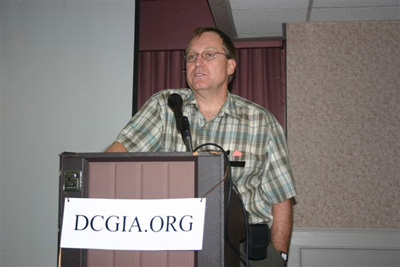
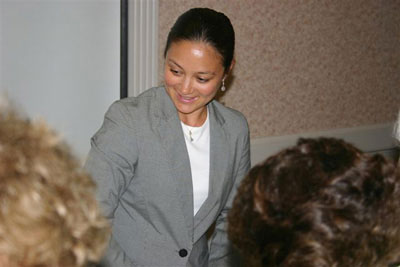
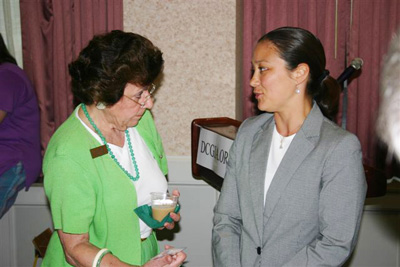
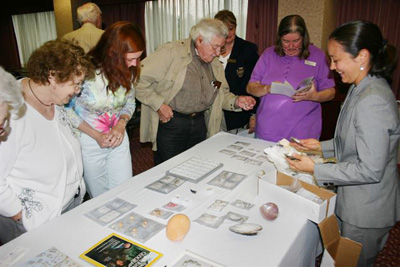
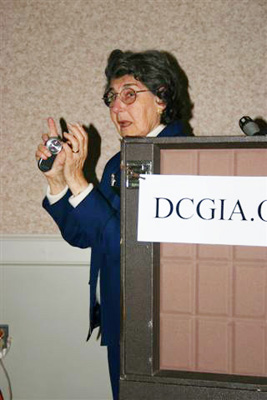
Daphne was a charming and enthusiastic lecturer. Her coverage of the workings and processes within the famous Christies auction house gave the audience an intimate look into the world of fine jewelry transactions. Tales of the provenance of the items that passed through her hands were intriguing and educational. Her presentation included the sub-topics of Client Service which gave us a lighthearted insight on how to appease and please clients under the stress of fallen souffles and tiaras. First hand experiences with walk-ins led to some surprising finds, like a Cartier bracelet with Kashmir sapphires that sold for 2 million dollars in 2002 make her job fun and exciting.

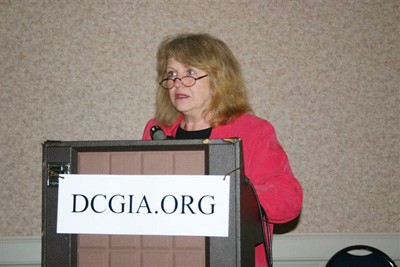
Chapter President Toby Fitzkee

Chapter President Toby Fitzkee

Signature pieces, like an almost overlooked fancy yellow diamond ring and an unsigned orchid brooch, as well as a Louis Comfort Tiffany necklace, whose signature holding clasp had been removed, were one of her sub-topics, which covered the difficult job of verification. To make things more exciting, facts like L. C. Tiffany not signing his pieces until his father had died, was precious information for those of us who do appraisal work and actually may see one of these pieces.

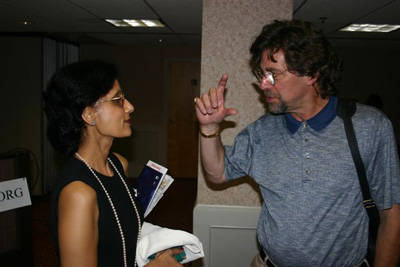
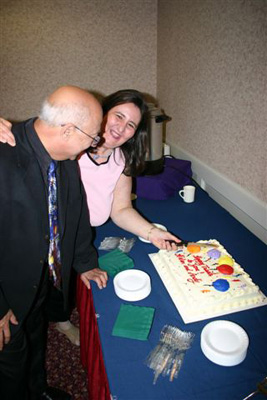
Kusam Malhotra and Ira Kramer

Kusam Malhotra and Ira Kramer

We heard about fierce competition between auction houses and were treated to spectacular pictures of jewels like a magnificent pink topaz necklace by Vedura and a stunning cabochon�citrine neckpiece by Seaman Schepps.

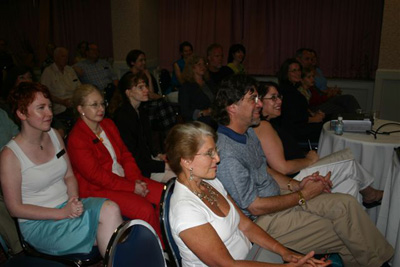
(Right) Brenda Forman, Ira and Davia Kramer, (Left) Allison Brady and Doris Voigt

(Right) Brenda Forman, Ira and Davia Kramer, (Left) Allison Brady and Doris Voigt

Her stories of rare diamonds and colored gems included the 62.2 carat Rockefeller sapphire, which sold for 3 million dollars, and a 1.72 carat fancy yellow-green turn-of-the-century-diamond ring that sold for 1 million dollars. An unusual Cartier signed necklace that had all of its colored gems removed was given an estimated selling price of $6000 to $8000 and sold for a surprising $55,000 dollars.
Tony Conway with raffle tickets

Celebrities and the stories of their jewels, from Evita to the colorful history of Doris Duke, added additional sparkle to a very memorable evening.

Written by Denise Nelson

Photos by Bill Scherlag

Posted in Meeting Archives | Leave a comment

Gina Latendresse

Monday, June 20, 2005

Diane Grimes and Gina

Gina Latendresse

On Monday June 20th DCGIA was privileged to hear Ms. Gina Latendresse. She talked about natural pearls with the emphasis on American pearls and the advent of the American pearl industry with its subsequent impact on world pearl production. She is the daughter of the renowned John Latendresse, who was founder of the American Pearl Company of Nashville, Tennessee, and was his protege and his heir. She is a well established pearl authority in her own right.

Diane Grimes and Gina

Diane Grimes and Gina

Ms Latendresse spoke briefly about the history of pearls as gemstone adornments. Historically they may have been the first gem. In 1299 Venice, only brides wore pearls: in 1599 only women married more than a decade were permitted pearls. Until recent history pearls were owned only by royalty and the very rich.

Lisa Carp, Etta Saunders, Russ Shew, Cathy Gaber and Gina

Lisa Carp, Etta Saunders, Russ Shew, Cathy Gaber and Gina

The acquisition of natural pearls declined with the advent of successful culturing in the late 1800s and, as a result, this cultured gem became available to the middle class at an affordable price. In 1906 only 1/10,000 marketed pearls were natural, in 2005 only 1/50,000 or perhaps 1/100,000. Most natural pearls are odd or baroque shapes because the actual nucleation is caused by any shell or parasitic intruder or any foreign epithelial cell. Therefore, the subsequent pearl is shaped accordingly. The price of natural pearls can be astronomical due to the very limited supply. At a recent auction a three-strand natural Akoya pearl necklace sold for three million dollars.

Davia Kramer and Mary Ehlers

Davia Kramer and Mary Ehlers

The American pearls harvested from the Mississippi and Tennesee rivers are natural and come in baroque shapes designated as “feather, bird, turtleback, rose bud, and wings.” They lend themselves to fantastic, imaginative jewelry. Five percent of these pearls have natural hues of pink, blue and gold along with various shades of white. These natural pearls are not enhanced in any way. Very few natural pearls are derived from other sources today.

Mary Ehlers, Bob Davis, Ann Escobar and Gina

Mary Ehlers, Bob Davis, Ann Escobar and Gina

The pearling industry started as a by-product of related industries such as seafood harvesting, restaurant preparation, mother-of-pearl buttons, utensil manufacturing, and many others.

The major part of today’s pearls are cultured with the introduction of a shell bead nucleus and foreign mantle cells around which the nacre grows for a specified period of time, and is then harvested. The longer the time in the water, the thicker the nacre and the more costly the pearl. The resultant pearl is priced according to many factors: nacre thickness, luster, color, size, shape, and surface perfection. Sixty percent of the shell beads used for nucleation are derived from American fresh water mollusks. Currently China is experimenting with different sources of nucleation material but with limited success. Today almost all pearls are cultured and enhanced.

Lois Berger, Russ and Helen Shew

Lois Berger, Russ and Helen Shew

Mollusk pearls come from many sources around the world and are derived from several different species that give their own genetic characteristics to the resultant pearls. These include size, color, and shape such as golden pearls from the gold-lipped oyster. Some unusual pearls presently being found are natural black pearls from Mexico and Venezuela, abalone with baroque shapes and mabes from California, rare gastropod flame-patterned conch “pearls” from the Caribbean, and its even rarer Vietnamese relative, the “melo melo.” Other mollusks or gastropods can also produce a protectively coated inclusion or “pearls”.

The evening flew too quickly. The audience was given a rich palette of information, descriptions, and history and left it looking for more, hopefully not too far in the future.

Written by Lisa Carp

Photos by Bill Scherlag

Posted in Meeting Archives | 1 Comment

Gems and Jewels

A Timeline of Gemstone Discovery and Synthesis

Thursday, May 05, 2005
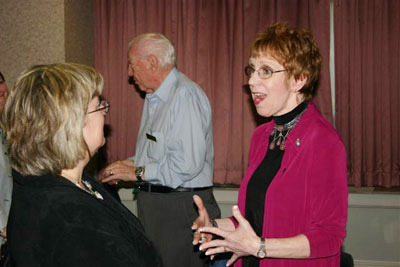
Christie Romero shares her enthusiasm with Denise Nelson and Bob Davis.

Christie Romero shares her enthusiasm with Denise Nelson and Bob Davis.

This month the Washington, DC chapter welcomed Christie Romero, who gave us the benefit of her expertise as jewelry historian and instructor with a talk on how the discovery and identification of gemstones has changed through the millennia.
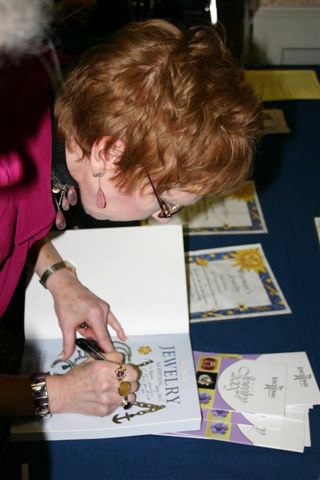
Christie signing her books for members.

Christie signing her books for members.

Christie professes to have a “date obsession.” She is very interested in the historic development of different trends in jewelry and demonstrated this with a number of examples from ancient, medieval and modern periods.

Christie began by discussing gems and jewelry from ancient times, giving a survey on the discovery and use of gemstones in such locations as China, Iraq, Egypt, and Mexico. A highlight of this portion of the talk was Christie’s description of the oldest known diamond ring, from the 3rd century A.D.
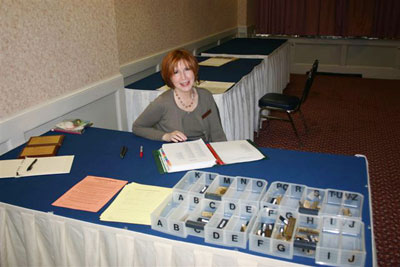
Chapter Secretary-Treasurer Michele Zabel greets all attendees.

Chapter Secretary-Treasurer Michele Zabel greets all attendees.

From 3500 B.C. – the heart of the Bronze Age – Christie showed us a picture of what is considered the earliest personal adornment. It was a yellow jade boar, or perhaps a dragon, depending on how it is viewed (and according to what ancient bestiary one considers authoritative).

She also showed us the first emerald ring, dated 330-300 B.C., made in Greece. During this period there was much confusion over topaz and olivine because olivine (peridot) was found on the island of Topazos.
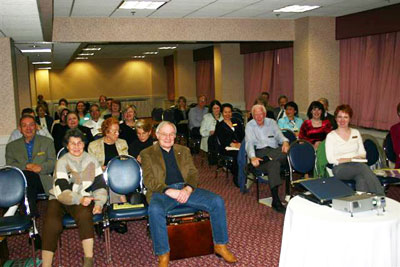
Part of our May, 2005 crowd for Christie Romero.

Part of our May, 2005 crowd for Christie Romero.

Moving forward through the centuries Christie related interesting facts such as Charlemagne’s decree that a person could not be buried with his or her jewelry. She explained that many cultures held the belief that gemstones could convey powers to the wearer – but only if they touched the skin.

Christie emphasized the commonly used method in the past of classifying gems by color (for example, all red stones as rubies, all blue stones as sapphires, etc). Only much later, and through greatly developed scientific tools and techniques of classification, would we find out that such important gems as the Black Prince’s Ruby, found and labeled in 1367, is actually a red spinel.
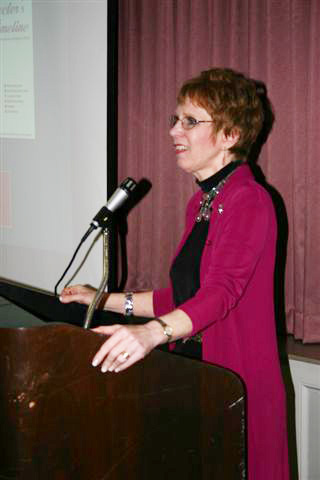
Christie made a fact-filled presentation.

Christie made a fact-filled presentation.

Christie explained how in the last three hundred years gemstone discovery became more geographically widespread, and the appeal of a greater variety of gemstones began to grow. By the 18th century diamonds were mainly found in India and Brazil. The “Dresden Green” diamond – an extremely rare color – was first presented to King George in 1722. In the 19th century, amethysts and alexandrites were discovered in Russia and tourmalines were found in Maine. Opals were popular in the late 1800s. The “Eureka” diamond was the first diamond found in South Africa in 1866-1867. The discovery of diamonds in South Africa is one of four factors that contributed to the wearing of diamonds in the last quarter of the 19th century. The other three are the rise of wealthy industrialists and financiers, improved diamond-cutting and setting techniques and machinery, and the invention of the electric light bulb in 1879.
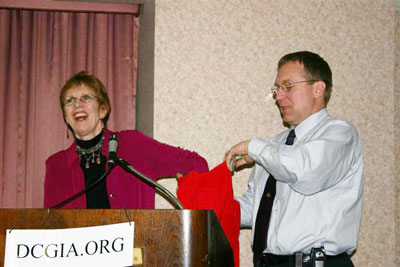
President Toby Fitzkee has Christie picking the winning ticket.

President Toby Fitzkee has Christie picking the winning ticket.

Christie changed gears at this point to focus on synthetics in the 20th century. Among the milestones in this period were: the Verneuil flame fusion technique (1902), the Czachralski pull method (1918), and the introduction of Alexandrite-like corundum (1909). Synthetic sapphires were used widely in 1920-1925 with diamonds set in either white gold or platinum. There were natural pink diamonds from Australia’s Argyle mine in the 1990s

One of the reasons Christie’s talk was so fascinating was that she chose to illustrate her points by putting jewelry in context with pictures of places and artwork from the time that it was crafted. Christie presented a fabulous photo of the “Mughal,” a 217.8 carat emerald, inscribed and dated in India in 1695. She also showed us a revealing map of the ancient trade routes, which both started from and returned to Rome. This gave us a very illustrative account of how the places of gem discovery and trade affected one another.
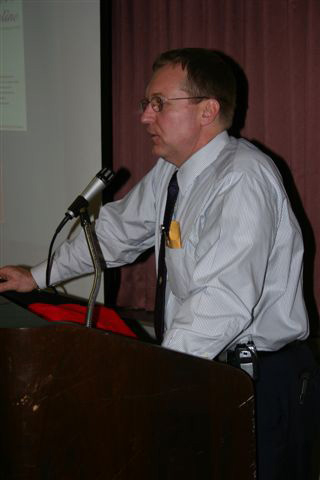
President Fitzkee announces future speakers and events.

President Fitzkee announces future speakers and events.

Christie made important note of citing expertise, and quoted Jack Ogden, Rose Tozer and our own Fred Ward in support of her arguments and claims. She stressed the importance of having original documentation when citing the provenance of gems and jewelry, and that one should not simply repeat secondary source material, because she can, in so doing, unknowingly perpetuate incorrect information. Misnomers and misidentification can cause major confusion.
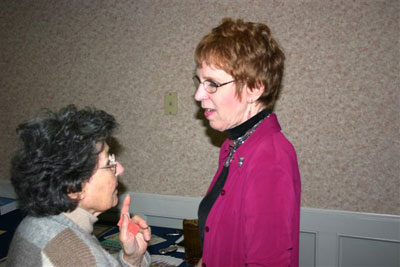
Lois Berger speaks to Christie about the use of pearls.

Lois Berger speaks to Christie about the use of pearls.

We were very fortunate to hear so much of the wonderful and educational history of gemstones and synthetic stones from Christie and recommend that anyone take advantage of her books and seminars at every opportunity!
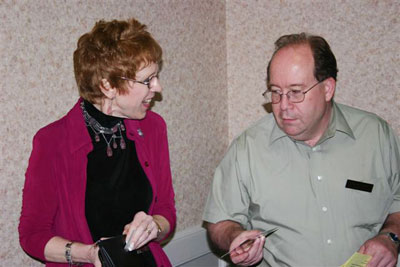
Christie with chapter member Roger Bucy

Christie with chapter member Roger Bucy

– Allison Brady

Photographs by Bill Scherlag

Posted in Meeting Archives | Leave a comment

Tuscon Panel

Monday, April 13, 2005

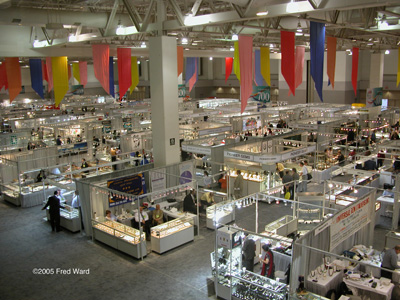
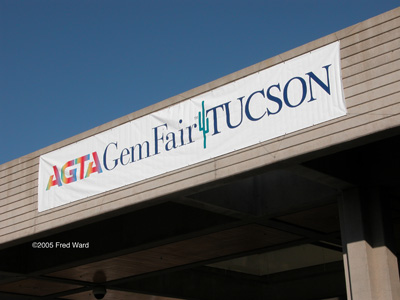
Our original Tucson panel meeting and discussion (held annually in February) was snowed out this year and finally convened among the cherry blossoms on April 13th. The Tucson panel is an annual event of the DCGIA chapter to inform and educate the members about what was new, special, unique, provocative and stimulating at the gem and jewelry super market called the Tucson Gem and Mineral Shows.

GIA-Tucson-Panel-05-01.jpg

This year’s PowerPoint presentation led off with Lois Berger, our resident pearl expert, discussing pearl trends from a variety of pearl types, their environmental issues, sources, grades, availability of such pearls, and wholesale costs. Examples of numerous pearl types were on hand examination.

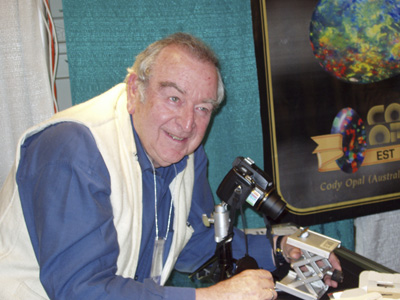
Following this we were shown spectacular opal photographs by Fred Ward. They were reminiscent of kaleideoscopes with brilliant color and flash.

As a finale to the evening, Vice President Bill Scherlag summarized our Tucson overview and was followed by Denise Nelson, who concentrated on the human aspect of the shows with buyers, dealers, onlookers, and gems mixed into one grand memory.

After the presentation various DCGIA members showed and discussed many pieces from of their own finds. As usual, the annual Tucson Panel is one of our most popular yearly events.

Opening day at the AGTA exhibit.

Opening day at the AGTA exhibit.

Fred Ward received two awards from GIA President Bill Boyajian: Member of the Year and he accepted our DCGIA award for Chapter of the Year.

Fred Ward received two awards from GIA President Bill Boyajian: Member of the Year and he accepted our DCGIA award for Chapter of the Year.

Fred photographing opals in Tucson.

Fred photographing opals in Tucson.

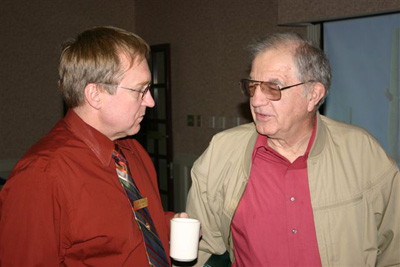
Chapter president Toby Fitzkee with Hap Williams.

Chapter president Toby Fitzkee with Hap Williams.

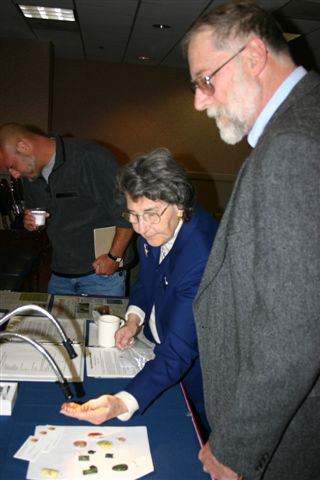
Pearl specialist Lois Berger with Courtland Lee.

Pearl specialist Lois Berger with Courtland Lee.

Andy and Helen Herman's farewell cake as they move to Arizona.

Andy and Helen Herman’s farewell cake as they move to Arizona.

Lois Berger's pearl presentation.

Lois Berger’s pearl presentation.

Denise Nelson speaking about the human side of Tucson.

Denise Nelson speaking about the human side of Tucson.

Text by Lisa Carp

Photographs by Bill Scherlag and Fred Ward
Posted in Meeting Archives | Leave a comment