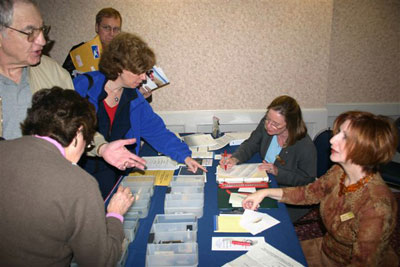
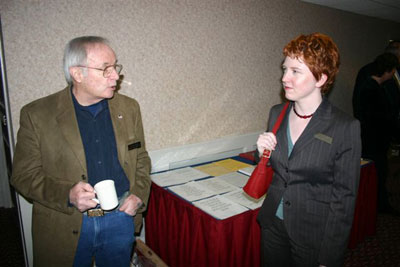
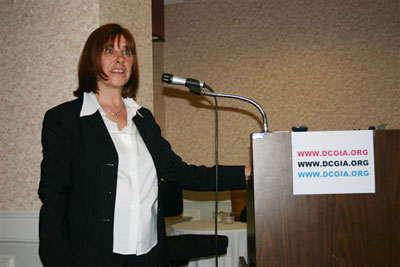
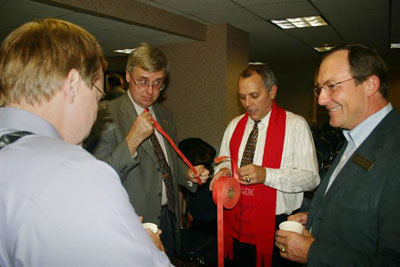
Dr. Jeffery Post

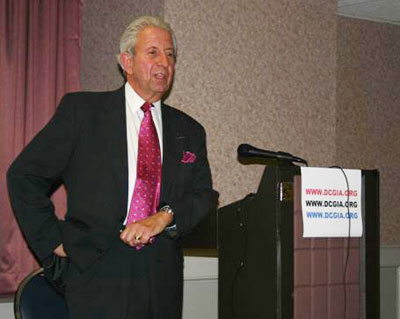
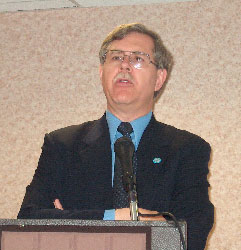
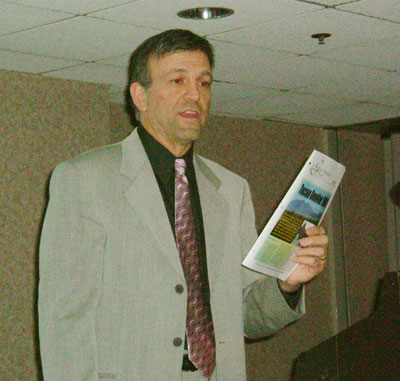
Dr. Jeffery Post, Geologist and Curator-in-Charge of the Mineral Collection of the Smithsonian Institution, was our speaker at the May 15th meeting of DCGIA. He gave a brief history of the Hope Diamond and then described recent research at the Smithsonian on the Hope that has cleared up a lingering mystery.
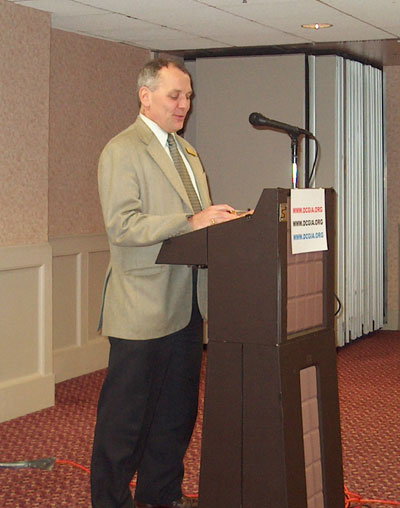
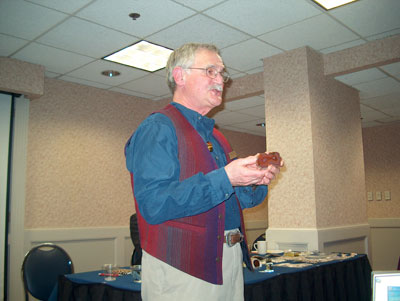
Jeff-Post-closeup-sharing-h.jpg

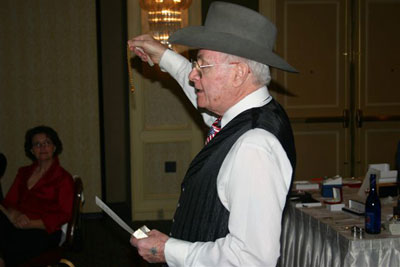
Jeff Post sharing his research on Hope Diamond

The Hope Diamond is the most popular draw in the Smithsonian for several valid reasons-

  1. It is the largest deep blue diamond known. It weighs 45.5 carats.
  2. It is priceless.
  3. It has a long history.

John Baptiste Tavernier sold to King Louis XIV of France a parcel of fifteen stones in 1668 that included the tabular blue diamond that would later be called the Tavernier (112 and 3/16 ct). It is believed to have come from India. The Tavernier was cut into the French Blue by order of King Louis XIV in 1673 and set in the bottom of the plaque for the tricolor Order of the Golden Fleece for the French king. The stone had been cut to emphasize size rather than brilliance, so King Louis had it re-cut to improve its brilliance. It then was in a heart shape and weighed 67 and 1/8 carats.In 1749 Louis XV had the diamond, by then known as the “French Blue,” set in a piece of jewelry for the “Order of the Golden Fleece.” This piece contained a large white diamond, a red spinel, as well as the French Blue, and it was most elaborate. During the French Revolution in 1792 the Crown Jewels were stolen, including French Blue. The red spinel eventually reappeared, but not the French Blue.
Hope-Diamond-opening-slide.jpg

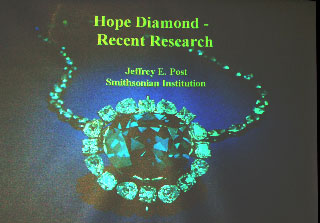
Most of the evening centered around unraveling the story
of the French Blue diamond and how it is now proved that
the legendary Hope Diamond was cut from the French Blue.

In 1812 a large blue diamond weighing 45.5 carats appeared in London and was believed to have sold to King George 4th in 1820. One account says that at the King’s death it was acquired by Henry Philip Hope. The stone bears his name to this day. According to Ian Balfour, on page 128 of his book, he writes that “no evidence has been forthcoming to suggest that King George IV ever owned the Diamond,” speaking of the Hope.
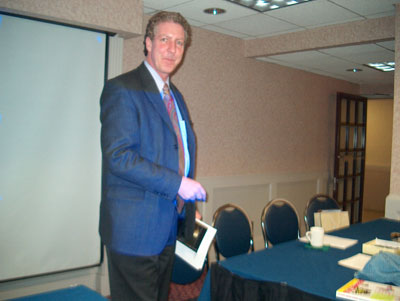
Chuck-Hyland-juggling-raffl.jpg

Chuck Hyland juggling the chapter’s raffle tickets

The Hope family sold the diamond in 1901. It passed through several hands and eventually was acquired by Pierre Cartier, who showed it to Evalyn Walsh McLean in 1910 while in Paris for her
honeymoon. Her father, Thomas Walsh, became rich when he struck gold in Colorado in 1986. She bought the Hope Diamond from Cartier in 1912. About this time stories began to surface that the stone brought bad luck. Evalyn married into the McLean family who owned the Washington Post and the Cincinnati Inquirer newspapers. Harry Winston purchased the Hope Diamond from Mrs. Walsh’s estate in 1947. Harry Winston then donated the Hope Diamond to the Smithsonian in 1958. A mail courier simply carried the Hope Diamond, wrapped in a brown paper bag placed in a plainly wrapped package, up the steps that led to the Smithsonian’s door. Winston’s donation to the Smithsonian in 1958 became the foundation of the National Gem Collection where the Hope Diamond can be seen today in the Winston Gallery of the Smithsonian’s Museum of Natural History.
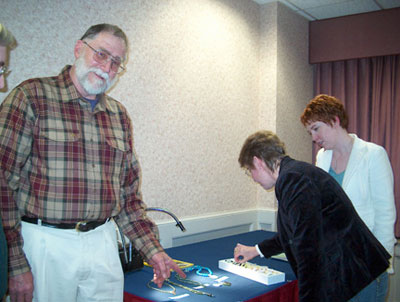
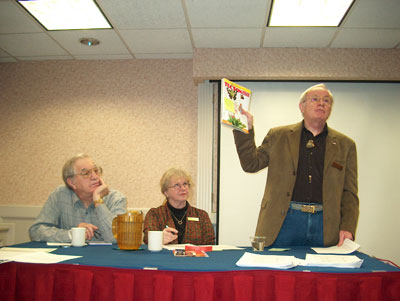
Chuck-Hyland-with-Dr.jpg

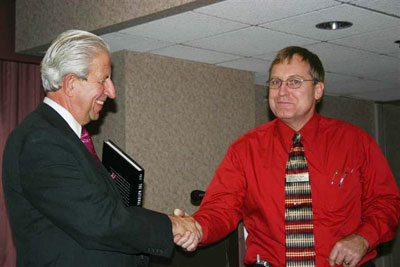
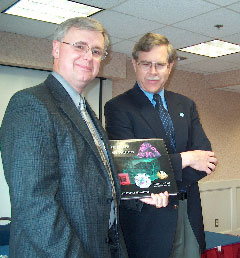
Chuck Hyland admires Dr. Jeff Post’s book on the Smithsonian’s gem collection

Jeff also described the phosphorescence of the Hope Diamond as being an intense orange-red. It is only visible in a dark room after exposure to ultraviolet light. Orange-red Phosphorescence is almost exclusively limited to deep blue diamonds but the Hope seems to be unique in the intensity of its phosphorescence and the length of its eery glow (two to three minutes). Spectroscopic studies show that boron causes the phosphorescence as well as the blue color. It is the combination of the red and blue peak in the spectrum that produces the intense orange. Other blue diamonds show less intense orange phosphorescence from the red and blue peaks, but the height of the peaks is reversed.
Jeff-Post-and-Toby-Fitzkee-.jpg

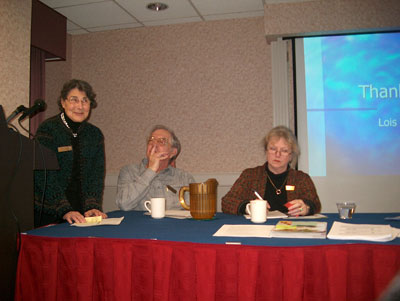
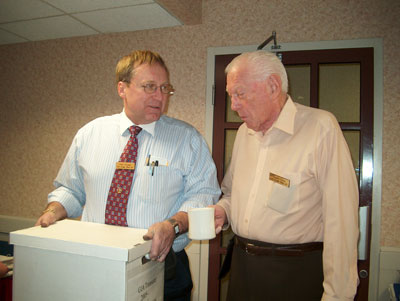
No DCGIA meeting ends until the guest speaker
reaches in and picks the winning lottery ticket.
CZ-renderings-of-the-origin.jpg

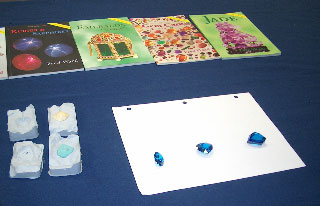
These replica CZ pieces now show how the French Blue
Diamond was cut to yield the ever-popular Hope Diamond.

This was a very interesting and enjoyable talk on one or the most famous gemstones in the world.

===========================================================

Addendum to John Lees’ write-up by Fred Ward

There is an intriguing behind-the-scenes story that we should add to John Lees’ text about the meeting. Three friends out West did all the math, the cutting, and grunt-work that made this piece of history possible. Nancy and Steve Attaway (whom many of you know and see at Tucson annually) and Scott Sucher comprised the team that actually rendered the three-dimensional solid object computer modeling and who faceted replicas of these famous diamonds for the Smithsonian.
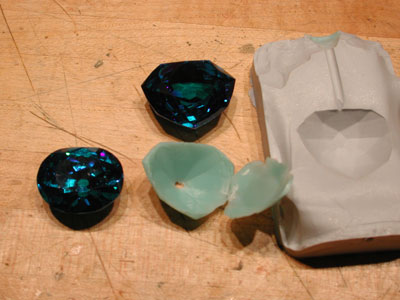
Hope Diamond Rubber Molds

These rubber molds were combined with wax and replicas to determine the largest stone that could be cut from the re-cutting of the “French Blue” diamond into the Hope. The thickest part of the wax was about 2 mm.
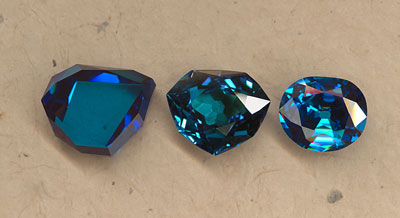
Three Replicas

These three replicas cut in cubic zirconia of the Tavernier, the French Blue and the Hope. The Tavernier and the Hope were cut by Scott, and the French Blue was cut by Nancy. From these the researchers could see how the Hope was cut from the French Blue.
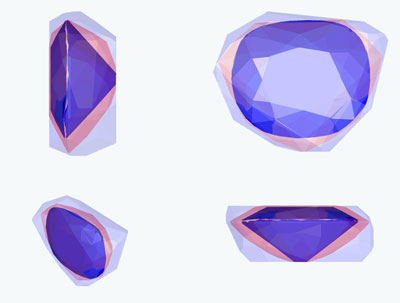
Computer renderings from different angles

These computer renderings from different angles to show how we believe the Tavernier, the French Blue, and the Hope fit within each other. Pale gray is the Travenier; orange is the French Blue, and blue represents today’s Hope Diamond.

Here is Nancy filling in the details about cutting and faceting replicas of the historic gems:

“Scott Sucher cut a fabulous CZ replica of the Tavernier, and I cut a wonderful replica of the French Blue. From data gathered by digital photography and photomodeling software, Steve mapped out a very accurate diagram of the actual Hope Diamond, and Scott Sucher cut a replica for the Smithsonian of the Hope using this new data. (The Hope Diamond was removed from its diamond-studded Cartier setting twice for us in 2004 so we could photograph the stone.) This new cutting data of the Hope Diamond we obtained is now proprietary to the Smithsonian, as they claim it for security reasons, much to the dismay of those faceters who cut replicas of the world’s famous diamonds. Steve, Scott, and I spent days and days and days at the computer terminal working out as accurately as we possibly could the solid geometric representations of the Tavernier and the French Blue so we could compare them and determine how one might fit into the other. Steve spent more than 100 hours of computer time working on these problems, and the whole project took nearly all of 2004. While history documented that the French Blue was cut from the Tavernier, we determined that the Hope was cut from the French Blue because of how it fit snugly into the French Blue in only one way. The June, 2005 issue of Lapidary Journal published my article describing our involvement in the project, what all we did, and why we did it. I’m glad to share it with DCGIA.”

Text by John Lees
Additional gem text by Nancy Attaway
Photographs by Doris Voigt
Posted in Meeting Archives | Leave a comment

Cutting Edge Issues and Answers

“Cutting Edge Issues and Answers”

Richard Drucker, publisher of The Guide, joined DCGIA for an entertaining and visually rich presentation on April 19th. He addressed a myriad of topics that ranged from current gem treatment detection and their respective effect on pricing, to gem nomenclature, to diamond cut grading and light performance, to new information about HTHP that is not widely know. If you couldn�t join us for the lecture, you missed the Indy-500 of slides and new information in the gem world.

Richard Drucker speaking

Richard Drucker speaking

By this time, everyone in the industry should be aware of beryllium-treated padparadscha sapphires. The prices on this once rare variety have taken a nose dive to $8.00-$50.00 per carat due to various concerns, among which include consumer confidence. However, the AGTA laboratory has recently issued an alert that there are now blue sapphires with beryllium treatment in the market. Be on the lookout! Beryllium also produces yellows and blues in addition to the well-known orange color.

Courtland Lee, Richard Drucker and Bob Davis

Courtland Lee, Richard Drucker and Bob Davis

Drucker also addressed the extreme heat treatment of gemstones, focusing on Mong Hsu rubies as an example. He pointed out that many of these natural rubies are heated to high temperatures using flux to protect them�and the glass residue that seeps into feathers can produce inclusions that have the same appearance as synthetic rubies created from the flux process. GIA is doing new research on the treatment of sapphires, rubies, and alexandrite, and that information will be available in the near future. GIA is also issuing new emerald reports in a standard report that will include the level of treatment but not the type of treatment.

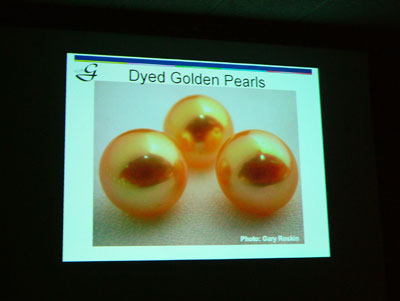
One of the many issues covered was dyeing pearls

One of the many issues covered was dyeing pearls

Consumers have taken great interest in the topic of gem treatment recently and are better educated about the various treatments. This has resulted in a movement back to natural-colored gemstones and a strong increase in collector demand. Prices of unheated material are rising, and there is also a shortage of unheated material in the market. Stay tuned to The Guide to track market pricing of unheated material for rubies, sapphires, and emeralds in particular.

Richard Drucker and Toby Fitskee

Richard Drucker and Toby Fitskee

There are an amazing amount of pearls coming out of China recently. Golden Pearls are enjoying a big impact in the market in the last few years. Many of them are treated to produce the golden color. Look for a reddish overtone as proof that they are dyed golden. However you should note that its absence doesn�t prove the color is natural. Drucker predicts that we will start seeing more Vietnamese cultured pearls. They are bead-nucleated, but in the last three months of the process they are sent to Japan, where the colder water will produce a tighter nacre formation, resulting in a higher luster. The colors are subtle, the nacre is thick, and a 4-4.5mm strand is running about $250.00 wholesale. The other issue rippling through the pearl industry is nomenclature regarding tissue-nucleated vs. bead-nucleated. If a lab report identifies a tissue-nucleated freshwater pearl as having “100% nacre thickness” and natural pearls are 100% nacre, the concern over nomenclature becomes immediately apparent.

Someone with Bobby Mann

Someone with Bobby Mann

From corundum to emeralds to topaz to pearls, or any gemstone, Drucker urged appraisers and jewelers to fully disclose any treatment to clients. He also proposed that we shouldn�t be afraid to say “I don�t know” and have the gem sent to a laboratory for testing where necessary�but to use common sense, because simply asking a client, “How much did you pay?” can also provide a wealth of information.

Drucker also tackled the diamond market, focusing on cut-grade and light performance as well as intriguing new thoughts on HTHP. He reviewed GIA�s new cut grading system, which is also provided as a complimentary service at http://www.diamondcut.gia.edu. GIA focuses on standard 58 facet round brilliant diamonds only. Some of GIA�s new terms, such as “lower half length” and “star length,” are causing confusion when using GIA�s Facetware. Richard also notes that it is difficult to get below a “Good” rating when using Facetware. However, he points out that this new tool�long overdue�is under development and it will become even better over time.

Melanie Marts flanked by Denise and Dennis Nelson

Melanie Marts flanked by Denise and Dennis Nelson

He also went into an overview of the Gemworld International Laboratories (GIL) and its light and cut grading system. GIL focuses on rounds, modified rounds, and princess-cut diamonds. They also look at brilliance, fire, scintillation and efficiency in addition to cut proportions. His laboratory conducted some interesting independent market research. The research revealed that, of the diamond attributes, clients understand price best and fire/brilliance second best. It also showed that the most important factor in a diamond for the client is brilliance, followed by clarity.

Members' dinner with the speaker

Members’ dinner with the speaker

The topic of current industry issues and scams was also cause for concern. Between questions of opacity within the industry to recent bribery scandals to fraudulent practices on the Internet as well as on television, Drucker is apprehensive that consumer confidence will be shaken. Linked to this hesitation is the question of HTHP. DeBeers has created equipment to detect HTHP, but of the two pieces that are available for purchase by independent laboratories, the “Diamond Sure” and the “Diamond View,” neither detects that treatment according to their own literature. The one piece of equipment that is supposed to be definitive for detecting HTHP, the “Diamond Plus,” is not available for purchase nor is there any information available on it. Drucker also mentioned that there was a huge stockpile of brown diamonds around from about 10 years ago, but this is suddenly gone from DeBeers. He also noted that rough diamond prices have soared while the polished have stayed the same, and wondered whether this is a coincidence.

Drucker ended the riveting evening with a call for transparency and cooperation within the industry, with the need for full information about standard test techniques developed and distributed to everyone in the industry. He made an appeal for full disclosure to clients. Without these two elements, consumer confidence is at risk.

Written by Etta M. Saunders, PhD

Photos by Tony Conway

Posted in Meeting Archives | Leave a comment

DIANA SINGER

MARCH 27, 2006

DCGIA spent an exciting, informative evening listening to Ms. Diana Singer, GG, telling anecdotal stories about the lives and works of four legendary American jewelers: Oscar Heyman, Julius Cohen, William Ruser, and Harry Winston. She accompanied her text with a PowerPoint presentation of their works and their achievements.

Diana Singer speaking

Diana Singer speaking

The post-World War II designs went from the elegance and extravagance of earlier periods to lighter, more whimsical, colorful jewelry. Dictated by the earlier wartime demands on materials, money, manpower, and time, the creation of unique superlative pieces was curtailed. Jewelers and designers were forced to use materials on hand and lesser quality stones from friendly nearby sources. Less precious metal was employed. Post-war saw the dominance of American design and creativity and initiated a new period.

Tony Conway introducing Diana Singer

Tony Conway introducing Diana Singer

Oscar Heyman was born in Russia and traveled for the house of Faberge, whose work greatly influenced his own. Later he worked part-time for Cartier and eventually opened his own shop on Maiden Lane in New York. The present day firm of Heyman and Sons is still located at that site.

Diana Singer announces winning ticket

Diana Singer picks winning ticket

The designs were classically elegant, tightly contained, and gracefully swirled.
He incorporated the use of baguettes and the motifs were repeated with minor variations. Similar pieces are still produced today. The firm is known for its three-dimensional bird and flower brooches and also for magnificent flag pins. The quality of the craftsmanship is due to the extreme care in the finishing of individual pieces; faceting the stones, solderless metal coupling, detailed and meticulous buffing, and fine detailing of the back, which also carries the firm�s logo.

Melanie Marts, Brenda Foreman and Lois Berger

Melanie Marts, Brenda Foreman and Lois Berger

Julius Cohen married one of the Heyman sisters and became a salesman for the firm. Later he went to Harry Winston in the same capacity. As a salesman he was larger than life, flamboyant and spectacularly successful. As a designer he used gold as the major component and decorated it with white and brown diamonds. (Was the use of brown diamonds the precursor of contemporary acceptance of this color?)

William Ruser was jeweler to the stars. Born in Chicago he moved to Beverly Hills in 1947 and opened his shop on Rodeo Drive. His clients were the most visible and famous of the Hollywood set. They often purchased personal jewelry which was also used in their particular films.

Courtland Lee showing his collection to Melanie Marts and Allison Brady

Courtland Lee showing his collection to Melanie Marts and Allison Brady

Ruser�s style was light and whimsical. His flowers were not as three dimensional as those of the Heyman Brothers. He carved the metals to give maximum light conveyance through the piece. Ruser�s motifs included angels, many of which were uniquely fashioned around a Mississippi River sweet-water pearl. He produced angels for the days of the week, for holidays, for pets, and for the nostalgic moments of life.

Harry Winston (Weinstein) was born in 1896. His father was a jeweler. Harry started his own business as a young man but it was subsequently stolen from him. At the age of 25 he began to buy quality estate jewelry at auction, sold it at a profit and established a client base. In 1932 the Harry Winston firm was incorporated. He, too, was a master salesman very tenacious and savvy. His Court of Jewels, 1949 through 1953, served to highlight his pieces and his company. Winston was never photographed while alive, a requirement of his insurance company to avoid kidnapping. However, our own Fred Ward photographed Winston for his National Geographic article, Diamonds, by keeping Winston�s face in darkness.

Allison Brady, Hap& Evelyn Williams, and new member

Allison Brady, Hap & Evelyn Williams, and Etta Saunders

Winston dealt in quality stones and often recut older stones for more modern settings. He purchased the 45.52 carat Hope diamond from the bedeviled Evalyn Walsh McLean in 1949 and donated it to the Smithsonian Institution in 1958, where it is on permanent display. His company was later sold to another corporation. Besides quality merchandise the Harry Winston company was also noted for the expertise of the design staff. Foremost among them was Shindi who often used his Indian tradition in the designs he rendered.

Currently the world of jewelry design, which had migrated from the old world to the new, is shifting to the Far East. India and China are major producers. Regardless, the old masters have left an indelible impression on the history of design and fashion. Their pieces now command an astronomical price and continue to rise in value.

Many thanks, Ms. Singer for taking us on this fabulous trip of introduction to the master American jewelers, Heyman, Cohen, Ruser and Winston. Well done!

Archive report by Lisa Carp

Meeting photographs by Doris Voigt

Posted in Meeting Archives | Leave a comment

The Tucson Panel

Tuesday, February 28th, 2006

The “Taste of Tucson” presentation was an evening filled with tidbits of information that left everyone wanting for more. It was truly an information-packed evening with many unusual items to be examined and shared.

Bruce Gaber

Bruce Gaber

To start off, Bobby Mann gave a enthusiastic historical overview of the Tucson Gem show history. Naturally it did include a dead Elephant (you needed to be there) and a fascinating chronology not previously known to many of the regular Tucson attendees. Tucson has been inhabited continuously for 4000 years and 7 million specimens are shown there during the gem show. With 34 Gem Shows covering 9 miles, it is the largest gem show in the world. In 1946 the Tucson Gem and Mineral Society organized and the show started a few years later with 9 dealers in a school auditorium. In 1972 the now famous Tucson Gem and Mineral Show moved into the new Convention Center and has been there ever since. The many shows now cover an ever-expanding time span of more than two weeks during the first part of February, and the show that started it all now ends the two week gem-feast. What once was the meeting place for prospectors, miners and collectors is now a necessary educational pilgrimage for gemologists, retail buyers, geologists and dedicated hobbyists. It has truly become Mecca for those who live by the words on an old bumper sticker that reads: “Old Rockhounds never die, they just go to Tucson!”?

Hap Williams, Denise Nelson, Bobby Mann

Hap Williams, Denise Nelson, Bobby Mann

Harold “Hap” Williams and his wife Dee were our Tucson Rookies this year. Hap gave us a view of what were the highlights for him. He mentioned things that old-timers often forget: the beautiful setting, the gorgeous hotels, and the well-working shuttle-bus service. The AGTA show seemed to have left quite an impression on him. Its bylaws covering treatment disclosures and the knowledgeable and forthright dealers confirmed that this show has achieved a standard that allows buyers an unmatched level of comfort and ease, not necessarily so with some of the outdoor shows. Harold and Dee’s new find was Saraphinite, a pretty dark green material from Siberia. They also recommended the many wonderful bookstores, antique stores, and encouraged bringing plenty of cash. It looks like they will likely return to Tucson next year.

Hap Williams

Hap Williams

Bruce Gaber’s photos allowed everyone a glimpse into the world of mineral specimens. He shared his “best of the best” and some of his personal favorite finds, like a marvelous piece of Patagonian Condor Agate. Bruce’s Tucson treasures included great shots of a very showy $400 specimen of Barite from Huanunco, Peru and white and yellow Calcite on Calcite from Artigas, Uruguay. Bruce spirited everyone’s mind away and beyond faceted and hand-structured materials into a world of absolute natural magic, of unusual formations, and of color combinations and textures rarely seen anywhere in the world. An exceptional $3000 Mexican Fire Opal left us wanting more.

Martin Fuller

Martin Fuller

Pricing and trends were covered by Martin Fuller. Martin is a firm believer in ongoing education and is a Tucson regular. He takes advantage of the many opportunities offered at the shows to expand his knowledge and to do research. He started to attending the shows in 1990. Martin emphasized the importance of using proper terminology as is the case with the various “Paraiba” named gems being marketed at the gem shows. It was very informative to hear about the current pricing changes and availability of material like Zircon. Changes in foreign Government regulations regarding the use of dynamite will change the availability of some gems that might once again become more readily available. The international marketplace has been affected by unfavorable dollar exchange rates and therefore it is likely that the consumer will see pricing changes in the near future. These detailed facts are essential for those who trade internationally and buyers for the American marketplace. The prices of Oregon Sunstone reflected its raise in popularity with some as high as $150 a carat. Martin agreed with Richard Drucker’s prediction that the interest in purple Sapphire is growing, also because nice material is available at fairly reasonable prices. To sparkle up an already very colorful presentation Martin brought with him a Painite specimen. It is listed in the Guinness Book of Records as the rarest mineral on the planet, and only 3.3 kg have been found so far. Thanks Martin for such an information-packed selection of hard facts and sharing such a rarity with everyone!

Lois Berger (Pearls), Hap Williams, Denise Nelson

Lois Berger (Pearls), Hap Williams, Denise Nelson

Our next speaker was Denise Nelson covering the topic of “color.” As always, there was plenty of it in Tucson this year. With one exception, one had to look hard for “natural” colors. There were many more gemstones with new unusual hues and colors along with low prices. Could it possibly be that the high cost of gold and other metals has produced a design-trend? Larger, low-priced stones can make up in showy-ness what the design lacks in metal. This may explain the apparently steady sales of 5+ ct low-priced gems. It may also explain why so many new color enhancements are found in the low-end gems like Topaz and Quartz, Green “Amethyst”, “Lemon” Quartz, “Raspberry” Topaz, “Mango” Topaz…..a buffet of color enhanced and “fruity” gems.

Diane Grimes and Denise Nelson

Diane Grimes and Denise Nelson

Brazilian Emeralds equal in color to their Columbian counterparts will be easier to purchase in the future due to new mining technology being imported from Europe. Especially the Belmont mine in Minas Gerais shows a lot of promise. Large quantifies of fine Tourmaline in all colors at very good prices are finally showing up in larger sizes. Tanzanite marketing will be worth keeping an eye on. Sight holdings and restricting the access to the freshly mined material may create a De Beers-like entity, and this area bears watching. A new marketing firm has started an aggressive advertising campaign, which depending on economic and financial developments, and the availability of large quantities of this relatively rare gem-stone, may or may not be a success.

President Toby Fitzkee and Robert Davis

President Toby Fitzkee and Robert Davis

Denise has spent two full weeks in Tucson every year for 17 years and finds the Tucson experience absolutely necessary to keep on top of current trends, gemological developments and mining news.Lois Berger, our in-house Cultured Pearl expert, presented an overlook of pearl availability, pricing and qualities. Lois has become a regular Tucson program highlight.

Rosa Shearin, winner of our GIA Scholarship

Rosa Shearin, winner of our GIA Scholarship

Apparently this year petal-pearls are hot and small fresh water pearls are not! One dollar strands of Fresh Water Chinese pearls were so abundant and are of such low quality that table after table at the gem shows were heaping full of them and they were not selling. Some pearls showed extremely high luster, which could possibly be attributable to some undisclosed treatment. In contrast, large round to slightly off-round fresh water pearls, of mixed natural colors, demanded higher than ever before prices. Metallic-looking natural color fresh water pearls are in high demand by designers and can cost as much as $800 to $1200 per 12 mm pearl. Who would ever have guessed? Chinese production, which once was booming is now dropping off, most likely due to development of the coastlines and past overproduction of low-value merchandise. The lack of an internationally standardized grading system also brings with it inconsistencies in marketing and difficulties in comparing pearls from different locations.

Large White South Sea pearls are still demanding top prices. One slightly graduated strand of 15 to 19 mm pearls had a price tag of $94,500. New smaller 7 to 8 mm South Sea pearls with fine luster are described as being the first harvest of the South Sea Black Lipped oyster. Mixed-origin, multi-colored strands, created by mixing large round natural color peach, mauve, white Fresh Water pearls with silver or black South Sea Tahitian pearls, are very popular this year and have been seen with a $8100 price tag. Lois brought with her some very lovely, high luster Coin-shaped and triangle-shaped pearls.

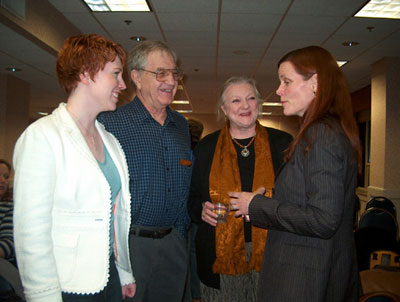
DCGIA members enjoying dinner in Tucson 2006

DCGIA members enjoying dinner in Tucson 2006

The Washington DC Chapter has always had a large number of members attend the Tucson show and every year they gather to share information (and to have fun) at a local Tucson Restaurant. This year the group got together at Mimi’s.

Written by Denise Nelson

Photographs by Doris Voigt
Posted in Meeting Archives | Leave a comment

DC GIA Alumni Lecture

Thursday, January 19th, 2006

Gary Roskin, gemstone editor of Jewelers Circular Keystone magazine provided a cornucopia (in his own words a �smorgasbord�) of information during a fact-filled evening. The variety of topics Gary covered reflected his great enthusiasm for gemology and everything related to it. Never was a presentation more all-encompassing and the evening�s quick pace can only be compared to a fast moving ride through the world of gemology: colorful, exciting and fun as well as intriguing! Gary�s inside knowledge of the stories he shared gave the audience the opportunity to hear many micro-lectures packed into one.

Tonight's speaker, JCK Magazine's Gary Roskin

Tonight’s speaker, JCK Magazine’s Gary Roskin

From tanzanite to green ziosite, from Paraiba tourmaline to Yogo sapphires, from Sweet Home rhodochrosite to zultanite we heard what was coming, going, and what is hot and what is not.

The details about Chinese freshwater mantle tissue-nucleated cultured pearls, many of which have been identified by laboratories as 100% nacre, will no doubt shake up the pearl trade a bit. Yes, this is a mouth-full, and yes it will be a challenge to explain these realities to a customer….! Some of these highly metallic looking fresh water strands are demanding prices of $11,000 and up. In contrast, abundant small beryllium-treated sapphires are selling now for around $8 a carat.

Chapter president Toby Fitzkee welcomes new members for 2006

Chapter president Toby Fitzkee welcomes new members for 2006

Long-time members Etta Saunders and Bobby Mann appear to be counting the house.

Long-time members Etta Saunders and Bobby Mann appear to be counting the house.

Not only was this evening chocked full of new topics, it also included some information-sharing, and hopefully we will hear more about Bobby Mann�s granular shell, which may shed some light on one of Gary�s gemological mysteries. Gary�s account of the small but awesome Idar-Oberstein gem show was impeccable. The �I am here, now what I do for the next three days?� question is quite appropriate as verified by someone who has been there.

Cathy Gaber and agate specialist Courtland Lee

Cathy Gaber and agate specialist Courtland Lee

Gary enlightened us about the changes which haven taken place in some of the major Gem laboratories like GIA and AGTA. AGTA has enriched itself with the presence of John Koivula, and Richard Hughes in addition to one of our recent speakers, Lore Kiefert. AGTA is obviously becoming a think-tank/powerhouse of gemological know how and expertise. Questions about the recent GIA lab bribery case and the resulting re-staffing of GIA�s NY laboratory in light of ethics and misconduct claims were answered as Gary clarified some of the information reported in the news media. The GIA changes in laboratory report price structuring and some policy changes hopefully will avoid problems like these in the future. Even though the case has apparently been settled, the diamond report issuing industry will most likely have to keep a very close eye on procedures to regain the trust of the public. The introduction of the new cut grade in diamond reports may be of interest to both the public and the trade.

A final task for Gary.... picking tonight's raffle winner

A final task for Gary…. picking tonight’s raffle winner

Diamonds as always are a hot topic and Gary shared the newest information about HPHT technology for fancy color as well as for colorless material. Beautiful photos of pink diamonds accompanied the story about the Argyle Pink Diamond tender in seven different cities around the world. The mine only produced 60 stones in one year and a 1.02 carat fancy deep purplish pink with a reddish cast took our breath away. Gary is not bashful about getting to the truth and telling it the way it is. However, he did say he liked the �Bazooka� bubble gum colored diamond best….not exactly a lab-approved description of color, but everyone agreed it was a beauty! Who knows maybe someday �Bazooka� will appear in some report somewhere! As we learned there are many surprises yet to come, and hopefully Gary will keep writing about them!


Written by Denise Nelson

Photographs by Bill Scherlag

Posted in Meeting Archives | Leave a comment

Holiday Party and Auction Fun!

Sunday, December 4th, 2005

Once again the year ended with our annual DCGIA Holiday Party and Auction. And what a blast it was! Good company, great food, and lots of fun items to bid on. And if that is not enough, it was all for the good cause of allowing the Washington DC Chapter GIA Alumni to bring excellent speakers and programs to the DC area�s gem and jewelry professionals and enthusiasts.

At the silent auction table, new secretary Donna Sibley, left, thinks,

At the silent auction table, new secretary Donna Sibley, left, thinks, “Should I or shouldn’t I bid on it???” while Trisha Reaves says “absolutely, I want it!!”

At silent auction table, Dennis Nelson, Michael Veasley with Mila Gonzalez prepare to bid while John Lees admires the goods!

At silent auction table, Dennis Nelson, Michael Veasley with Mila Gonzalez prepare to bid while John Lees admires the goods!

Kathy Refai and Kathleen Ewell discuss bidding strategies.

Kathy Refai and Kathleen Ewell discuss bidding strategies.

For the first time the gathering was held at the Fairview Park Marriott, in Falls Church, Virginia. The room was filled with members and guests and seven tables held mountains of donations. The 300+ items ranged from the generous donation of a brand new jewelers workbench, donated by James Burick of the �Jewelers Warehouse,� to beautiful food-baskets and wines. Many great books, plenty of gemological equipment, unique jewelry and a colorful array of gems kept everyone busy at the silent auction tables. Handcrafted items like beautiful pewter cups made by Bruce Gaber, appropriately accompanied by a bottle of Saki, shed light on the many talents of the chapter�s members. The items were varied enough to fit every budget and everyone seemed happy to go home with the items they most wanted.

Audrey Hagedorn and Bobby Mann try to out bid each other at the silent auction table.

Audrey Hagedorn and Bobby Mann try to out bid each other at the silent auction table.

Brenda Forman and Carolyn Chappell seem to be having a very good time.

Brenda Forman and Carolyn Chappell seem to be having a very good time.

Our diamond necklace auctioneer Bruce Gaber.

Our diamond necklace auctioneer Bruce Gaber.

The bidding was lively and our auctioneers, Bobby Mann, Bruce Gaber and Carolyn Chappell, kept things moving at a good pace, with good jokes and a lot of good cheer sprinkled throughout. On one occasion fierce bidding erupted between the auctioneers themselves, who in the process tried to convince each other that �Friends don�t let friends drink White Zinfandel…� You had to be there…! Certainly all of the auctioneers deserved a heartfelt toast after an evening of hard work.

Bobby Mann auctioning another priceless bauble.

Bobby Mann auctioning another priceless bauble.

Henry Ziegler's attempt to be the highest bidder and intimidated Denise and Dennis Nelson....................he won the prize!

Henry Ziegler’s attempt to be the highest bidder and intimidated Denise and Dennis Nelson………………..he won the prize!

Alan Chen, Michele Zabel, Theresa McGowan, and Chuck Pasco.............all enjoying the auctioneers antics!

Alan Chen, Michele Zabel, Theresa McGowan, and Chuck Pasco………….all enjoying the auctioneers antics!

White Cyclamen plants were decorated with burgundy colored accents to match the table-linens and the beautiful place cards also matched the decor. Michele Zabel�s artistic and detail-oriented talent added glitter and elegance to the festive gathering. It was a real treat to see so many people contribute, help, and work together. The big winner of the 50:50 raffle was Ellen Arthur. Everyone else�s reward came in the form of the Tiramisu dessert that ended the lovely 4 course meal.

Happy Holidays, Good Cheer, and to All a Good Night!

Written by Denise Nelson

Photographs by Bill Scherlag

Posted in Meeting Archives | Leave a comment

Dr. Geza von Habsburg

Fabergé

Tuesday, November 8th, 2005

It was truly a royal pleasure to welcome Dr. Géza von Habsburg to our very well attended November DCGIA Chapter meeting! One cannot proceed without covering a bit of personal as well as professional history of the author, auction expert, and exhibit curator, and his subject of choice: Fabergé. Géza von Habsburg-Lothringen was born in Budapest, Hungary, a direct descendant of the Austro-Hungarian Emperor Franz-Josef and his wife Empress Elizabeth. He was educated in Switzerland, Italy and Germany and his professional path led him almost immediately toward the artistic treasures of Europe and Russia. His appreciation of beauty and elegance drove him to publish a number of books, among them Fabergé, Court Jeweler of the Tsars. His long list of accomplishments also includes being director of the Christie’s auction house in Geneva. An inborn amount of curiosity and stamina led him to become an expert in Russian history and the merchandise of the famous jeweler Carl Fabergé. Dr. von Habsburg seems to truly enjoy knowing and sharing the small details and the larger story of the creation of the house of Fabergé.

Dr. Géza von Hapsburg speaking

Dr. Géza von Hapsburg speaking

Who better to present this tale of priceless treasures created in the sparkling atmosphere of the pre-Bolshevik revolution, wealthy Russia of long ago?

The Russia of the Romanoff’s, in the late 1800’s, was the wealthiest country in the world. It’s royal family and patrons-of-the-arts created an atmosphere wherein a talented craftsman could reach his peak in creativity and was able to manufacture items made of materials not otherwise available. It is almost impossible to think of the Russian Royal family without also thinking Fabergé! This combination of talent, wealth and timing, which resulted in the creation of objects of breathtaking beauty, can only be called a remarkable and incredibly fortunate coincidence.

Davia and Mercedes have a good laugh

Davia and Mercedes have a good laugh

Sadly, because of the strong anti-Tsar sentiment after the revolution, most of the original priceless jewelry items, owned by the Romanoff family and wealthy Russians were torn apart and sold for their intrinsic value rather than for their provenance and beauty. It is only through finding some rare sketches and production catalogs that the true extend of what was lost can be known. The mystery of where these precious components went, probably re-cut and reworked, leaves us only to wonder..? Most of the items that did survive were gifts that the Royal family had given to their European relatives and had therefore avoided confiscation and destruction.

We had a full house for this important meeting

We had a full house for this important meeting

Gustav Fabergé was born in Germany, a descendant of French Huguenots. He was an immigrant to Russia, where he apprenticed in St. Petersburg. In 1842 he opened his own shop and by 1900 his son, Carl Fabergé (1846- 1920), owned large manufacturing houses in Moscow and St. Petersburg. He had hundreds of employees. These brilliant craftsmen and women created not only jewelry but also intricate items such as picture frames, elaborate boxes, silver bowls and table-wear, clocks and almost anything else one could commission to be made. The Carl Fabergé workshop held a position of unequaled importance for many years. The exquisite enameling work, the use of large numbers of tiny diamonds and the delicate replication of subjects of nature, combined with the use of Russian gems like demantoid garnets and nephrite jade, gave them little competition within Russia. In 1908 however Cartier was also made “Royal Jeweler” and a number of foreign designers, including Boucheron, opened up shops in Moscow thereby creating a more competitive environment.

Lois Berger and Denis Nelson trade stories before the meeting

Lois Berger and Denis Nelson trade stories before the meeting

At the 1898 World’s Fair in Paris, the precious objects in Fabergé’s salon attracted much attention, but the French critics deemed many creations “too old fashioned” for the nouveau-inspired times. Fabergé’s use of bold color combinations and the use of moonstones, star-sapphires, dendritic moss agate and cabochon-cut gems gave his items a rather unique eclectic feel. This characteristic however, along with superb craftsmanship, would prove to be of timeless popularity and appeal.

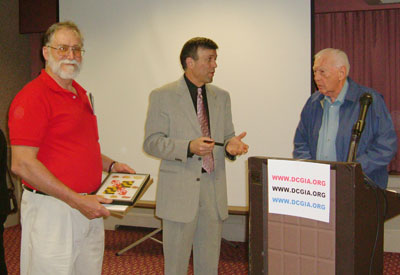
Dr. Hapsburg receives our gift book from Chapter President Toby Fitzkee

Dr. Hapsburg receives our gift book from Chapter President Toby Fitzkee

Even today Fabergé items are in high demand, and much sought after. Unfortunately this popularity has created a marketplace in which Fabergé copies have become the standard rather than the exception. Adding to the difficulty of identification is the fact that after 1905 hallmarking was not required, and much of what his workshops produced remained unmarked. However, his hallmarks were returned to use years later, when Armand Hammer obtained the marking-stamps and used them to fabricate new Fabergé items outside Russia. Some skilled craftspeople were also exported to continue the manufacturing of finely crafted items elsewhere in the world. Therein lies the difficulty in dating and authenticating these creations, leaving open the question of the actual origin of items of Fabergé styling and ambiance.

As usual the sign-in table is the busiest place at our meetings. The chapter will miss seeing Michele in her roles as she retires from being both Secretary and Treasurer for several years.

As usual the sign-in table is the busiest place at our meetings. The chapter will miss seeing Michele in her roles as she retires from being both Secretary and Treasurer for several years.

Naturally, one could not expect this lecture to end without hearing about some of the approximately 50 famous royal Easter eggs produced for the Tsars and their families. The recent sale of the Forbes collection will actually facilitate exhibiting these items to be enjoyed by a broader general public in the land of their creation and elsewhere.

Chapter members Bobby Mann and Allison Brady

Chapter members Bobby Mann and Allison Brady

Though not a Gemologist, Dr. von Habsburg’s presentation was filled with interesting tidbits such as the fact that Fabergé’s favorite gemstone was pink topaz and that he used amethyst and aquamarine from Siberia. The fine quality of the slide presentation brought the topic to life and allowed everyone to be truly mesmerized by the “most beautiful jewelry of all time!”

Written by Denise Nelson

Photographs by Bill Scherlag

Posted in Meeting Archives | Leave a comment

Dr. Lore Kiefert

Laboratory Director of AGTA
Gemological Testing Center

Monday, October 3rd, 2005

Dr. Lore Kiefert, the Laboratory Director of AGTA-GTC, presented an extremely information-packed lecture. She introduced us to the inside workings of the AGTA Gem Testing Laboratory, the advanced instrumentation used, and the interesting results that often surprise even the best of experts.

Speaker Lore Kiefert

Speaker Lore Kiefert

Her PowerPoint presentation included a detailed array of photographs of many gemstones and their natural and enhanced characteristics. Dr. Kiefert shared the step-by-step processes needed to identify, find the origin of, and recognize treatments of the 400 to 500 gemstones handled by the laboratory each month. Currently some of the issues of most concern are the HPHT treatment of diamonds, the fissure filling of emeralds, and ruby and sapphire diffusion. The AGTA laboratory also provides quartz batch testing at very low costs as well as pearl identification.

Setting the stage for a raffle win

Setting the stage for a raffle win

New gemstones appearing on the market from new sources like Madagascar can create confusion as to origin identification. Lesser known treatments of synthetic materials with organic substances and heat also creates new challenges. Type identification of diamonds, which is essential in identifying HPHT-treated diamonds, was explained in detail. It was rather disturbing to hear that thousands of the fairly new beryllium-deep-diffusion treatment sapphires had been “certified” by an Asian laboratory as “natural” and were sold as such for several years. The current widespread use of this treatment explains why so many more orange colored sapphires are finding their way into the market-place, with proper disclosure still being rather inconsistent.

Lore shows examples to Chih-Shue Yan and Randy Petersen

Lore shows examples to Chih-Shue Yan and Randy Petersen

Determining color authenticity of pearls is also a regular part of the laboratory’s tasks, with Gulf-of-California pearls making a reentrance, having been an old source of naturally black and silver-colored pearls, often with a brownish to greenish overtone, and red fluorescence. Along with rare and valuable items, many imitation pearls are also submitted for inspection. With the popularity of items of organic origin, Dr. Kiefert shared some pointers as to the identification of dyed and resin-filled red and blue coral.

Bobby Mann and Dennis Nelson chatting

Bobby Mann and Dennis Nelson chatting

A huge amount of useful gemological information was covered, which triggered a good amount of discussion. Dr. Kiefert�s active involvement in the industry allowed her to speak about the new demantoid garnets from Iran, New Zealand sapphires, and a new mineral which was mistakenly first called “raspberry beryl,” but ended up being neither a raspberry, nor beryl. One very intriguing story about a rough emerald crystal, which still holds a secret in the form of a paper with Arabic writing, captured the interest of all who attended.

Chapter president Toby Fitzkee with Deborah Dern

Chapter president Toby Fitzkee with Deborah Dern

Dr. Kiefert is an impressive lecturer, reflecting her vast knowledge of the subject and her prolific writing background. She has a Masters degree in Mineralogy and earned her Ph.D. in 1996 and her FGA in 1998. Her courier has taken her from The Swiss Gemmological Institute to the AGTA Gemmological Testing Center in New York City, where she currently resides.

Written by Denise Nelson

Photographs by Bill Scherlag

Posted in Meeting Archives | Leave a comment

Al Gilbertson

The GIA Diamond Cut Grading System

Not even staying the night in a Holiday Inn Express would have prepared me for this evening. This evening, our diamond grading world changed forever.

Al Gilbertson has blessed us before, a few years back, when he came from GIA headquarters in Carlsbad, CA, to delineate the history of the American Round Brilliant Cut Diamond, and to bring us up to date on the state of the research which culminated in tonight�s presentation.

GIA's Al Gilbertson with chapter member Chuck Hyland

GIA’s Al Gilbertson with chapter member Chuck Hyland

Now, with the results of more than fifteen years of research and the examination of over 70,000 round brilliant cut diamonds, Al�s mastery of the topic made the mysteries of the 4th C a bit less of an enigma.

The GIA could have no better point man for the job of sharing this latest development than Al Gilbertson. He is a man with tremendous industry experience and an impeccable reputation for thoroughness. Al has worked tirelessly for years on this very project. It was an eye-opening evening that touched only the tip of the “eyes-berg”. GIA plans a three hour presentation on this topic in conjunction with the 2006 Door-Step program.

Shirleen Bradbury and Martin Fuller obviously enjoyed the evening

Shirleen Bradbury and Martin Fuller obviously enjoyed the evening

In a system simply comprised of three major descriptive components containing a total of seven sub-categories, based on a total of twelve measurements and observations, we arrive swiftly at one of five grades, to put it in a nutshell. In the end, we have Diamond Cut Quality Grade categories of Excellent, Very Good, Good, Fair or Poor.

To derive the new and improved Diamond Cut Grade, the GIA incorporates all of it’s current measurements and observations as noted on the present Diamond Grading Report, with several new measurements and observations. These new bits of information include star facet and lower half facet percentages, crown and pavilion angles, as well as girdle minimum and girdle maximum measurements. Mix it together and what have you got? One of the five new cut grades.

The curious result of these possible parameter permutations reveals that there is more than one way to cut a diamond of “Excellent” cut quality. At the same time, the current criteria for an “Excellent/Excellent” cut diamond will not necessarily give you an “Excellent” grade in the new system. You might not even rate a “Good”, if your heretofore “Excellent/Excellent” diamond is overly “painted” or dug-out”. Whew! It may be easier just to skin a cat. I still think beauty is in the eye of the beholder, but I’m just here to report the facts.

Speaker Gilbertson meets with members before the talk

Speaker Gilbertson meets with members before the talk

The new system will be implemented January 1st, 2006. We may be longer in tooth, but those of us who have lived long enough to see this system come to fruition should be ready to jump for joy. Everyone in the trade will have no trouble dancing to the beat of this new industry jig, as they’ll feel light as a feather once they’ve finished paying for their GIA DiamondDock (at approx. $1,650), standardized, balanced and consistent lighting and viewing environment. And if you can’t afford the Sarin or OGI machine (starting at $5,850), a $500 reticle will help you all who charge by the hour for appraisals.

For those who prefer the “Free” route, the GIA has developed an on-line cut grade predictor called, “FACETWARE” (just fill in your own observations). Before you do however, this is one EULA (Short for End-User License Agreement) you HAVE to read, because clicking the “I ACCEPT” button might turn your cursor into a cloven-hoofed curser. In particular, read the paragraph on PUBLICITY. (http://facetware.gia.edu/ ) I decided to decline, so I could legally relay my hopes and fears.

We had a large turnout for GIA's new Cut-Grade talk

We had a large turnout for GIA’s new Cut-Grade talk

As the president of Kassoy mentions regarding the new GIA system in his essay (New Diamond Cutting Grading Standards ), the Chinese character for crisis and opportunity are the same. The crisis is the challenge to the trade and the public to adopt a new set of stone tablets from on high with the high hopes that no one from the Color Master project had anything to do with this, and the opportunity is for equipment manufacturers to do what they do best, sell more gear.

In closing this Pandoran box, I would encourage everyone to learn as much about this new system as possible, because it, and several other new systems are making attempts at scoring the Cut Grade Grail. To learn more, go to the GIA information site, GIA | On Diamond Cut , as well as some of the discussion forums such as Pricescope Forums .

Knowledge is power. Most importantly, beauty is beauty, and it still lies in the eye of the beholder, and no one to my knowledge has the patent or copyright.

Martin Fuller, GG

Photos by Bill Scherlag

Posted in Meeting Archives | Leave a comment

Elyse Zorn Karlin

Jewelry and Metalwork in the Arts and Crafts Tradition

August 25, 2005

The Washington, DC GIA chapter hosted Elyse Zorn Karlin, author of JEWELRY AND METALWORKING IN THE ARTS AND CRAFTS TRADITION, on August 25, 2005.

Chapter president Toby Fitzkee with guest Eric Hoffman

Chapter president Toby Fitzkee with guest Eric Hoffman

Ms. Karlin�s very informative lecture/discussion included slides on her passion��Arts and Crafts jewelry. The brief history of the Arts and Crafts movement which she presented helped to create a reference framework in which to understand the uniqueness of this jewelry. Art Nouveau and Art Deco have a defined style, and one needs to study both periods in order to better identify pieces of jewelry that are Arts and Crafts. This jewelry was an extension of the movement before and after the turn of the 19th century.

Speaker Karlin with Davia Kramer

Speaker Karlin with Davia Kramer

William Morris is considered the founder of the Arts and Crafts movement in England. His furniture designs reflected his own reaction to the Industrial Revolution and a rejection of mass production. Ms. Karlin�s slide presentation of English and American Arts and Crafts jewelry pieces offered examples of English and American designers, many of whom were not jewelry designers per se but relied on an architectural background.

Robert Pellenbarg and Bruce Gaber

Robert Pellenbarg and Bruce Gaber

The value of a piece was in the craftsmanship, individuality, and imagination that were paramount in the hand-making of each one. Materials were not the important factor. Usually base metals or silver were used and stones were selected for color, not quality. Hammer marks were often visible. Twisted wire and enamel were important. There was a rejection of Victorian fashion with its stone-cluttered pieces. Designs were heavily based on nature and creators resorted to utilizing unusual materials such as coconut, shell, glass, abalone, and shagreen.

Speaker Elyse Zorn Karlin

Speaker Elyse Zorn Karlin

The Arts and Crafts movement spread throughout Europe and the United States. Several jewelry makers in Boston, Providence, Chicago, and New York as well as other cities produced quality handcrafted pieces for their high-end trade and did some mass production for middle class clients. Flowers, foliage and Celtic designs were often enhances with stones and enamels. Arts and Crafts jewelry creation ended with World War I and examples of these pieces have become highly collectible in the last two decades. Ms. Karlin�s book would be a valuable resource to any collector.

Written by Marcia Rickman

Photographs by Bill Scherlag

Posted in Meeting Archives | Leave a comment