Elyse Zorn Karlin – Slide Show Presentation

Elyse Zorn Karlin

Elyse Zorn Karlin

Elyse Zorn Karlin, a noted author and jewelry historian treated us to a trip back in time when gods and goddesses had free reign in the world’s psyche.

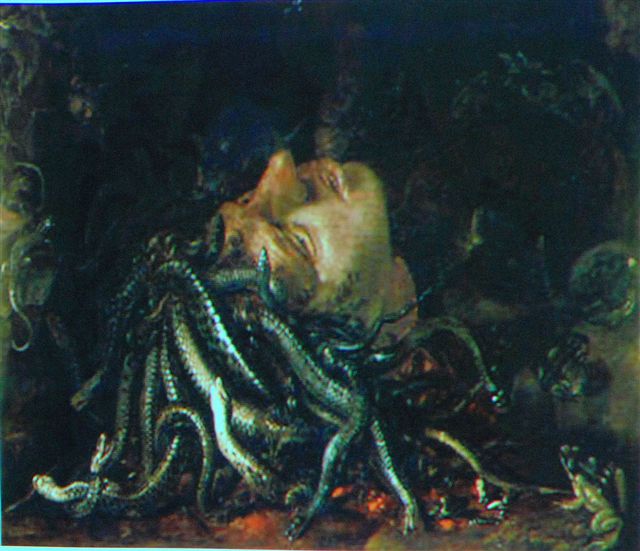
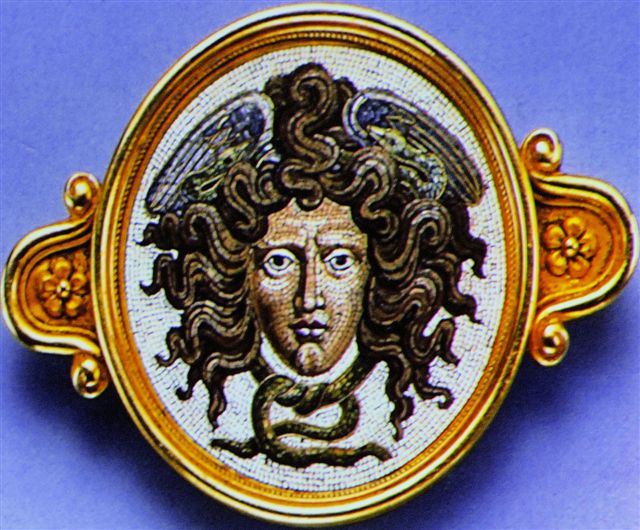
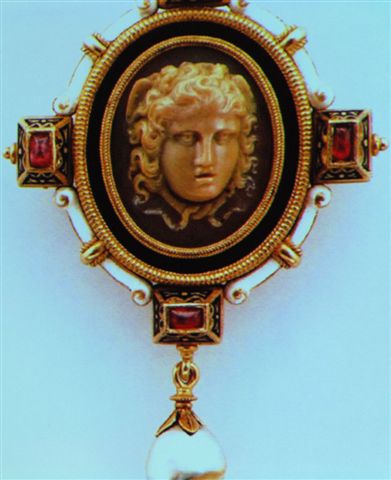
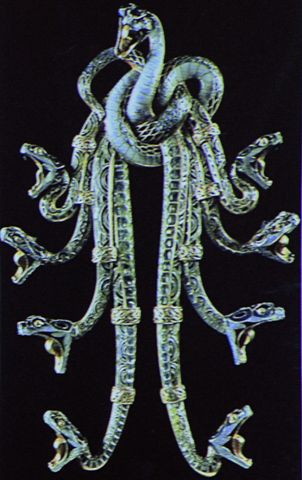
She spoke about Medusa and how this tragic yet beautiful creature has permeated the jewelry world from antiquity on.
She began by giving us the legend of this intriguing lady and how the duality of horror and beauty was used in jewelry and objects of art.
Nov1Nov2Nov3

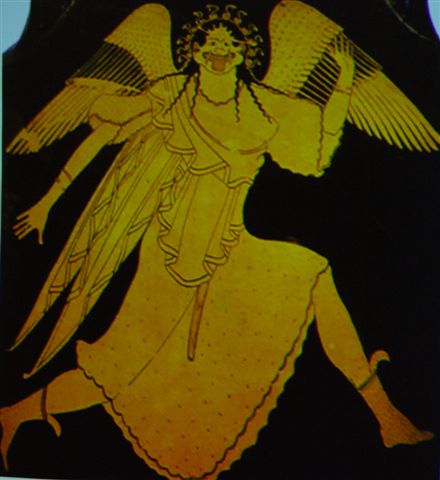
The story goes something like this….Medusa was a beautiful maiden, one of three sisters who captured the eye of Poseidon, the other two sisters being gorgons who shared a single eye. One day while worshiping in the temple of the goddess Athena, Poseidon ravaged the fair Medusa, who also believed herself to be more beautiful than Athena. Both Poseidon’s actions and Medusa’s own opinion so enraged Athena that she turned Medusa into a monster with snakes for hair and a gaze that would turn anyone looking at her to stone. Enter King Polydectes who was the ruler of the island of Seriphos where the mother of Perseus was being held prisoner. Perseus was very protective of his mother and didn’t want the king near her. Polydectes decided that the best way to get what he wanted was to get rid of Perseus by sending him on a mission to bring him the head of Medusa. This was going to be no easy task since anyone gazing upon Medusa was immediately turned to stone not to mention that the one-eyed sisters guarded her.

Nov4Nov5

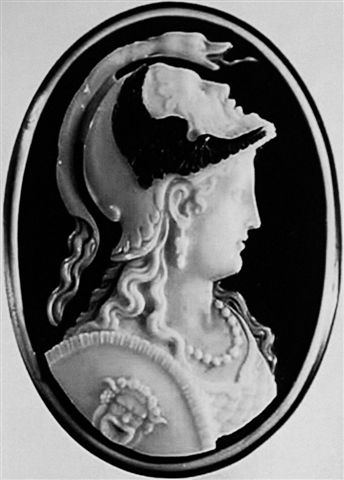
With help from Athena who supplied him with a sword and a mirrored shield, he accomplished his quest by looking at her reflection in the mirror instead of directly at her to prevent being turned into stone. When he severed the head, Medusa’s two children by Poseidon came spewing forth. One being Pegasus, the winged horse and the other being Chrysaor who is said to have been king of Iberia (Spain and Portugal). Perseus carried the head for a time and the corals of the Red Sea were said to have been formed when some of the blood spilled onto seaweed. He did take the head back to Polydectes who had forced his mother into slavery and was about to marry her. Perseus was so upset that he called upon his mother to shield her eyes and all but the two of them were turned to stone. He eventually presented the head to Athena who promptly attached it to her own shield.
Nov6Nov7
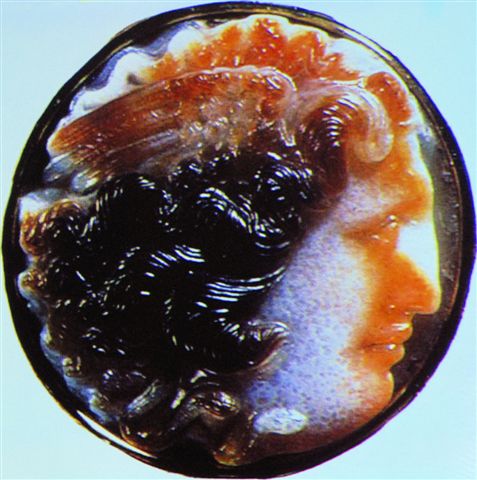
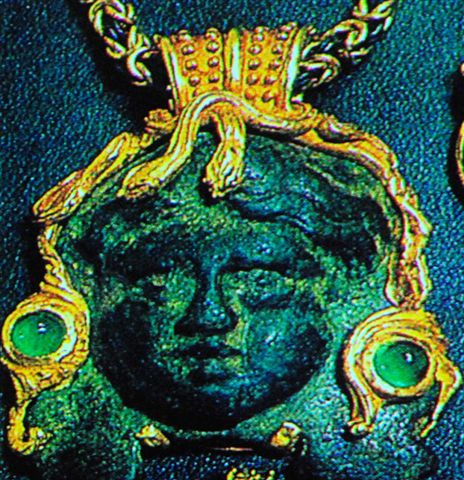
The Medusa image represents a fear of death, the personification of rape and at the same time, gentleness and sadness. Early depictions show here as having a very round head, large eyes, a lolling tongue and large teeth. The ancients most often showed her facing forward as opposed to profiles in more modern times. The image was produced on coins as well as cameo carvings in stone. In many images, the snakes are tied under her head. Some early depictions also show her cradling her son Pegasus as her head is being severed, thus showing the horror and at the same time gentleness.
Nov8Nov9

With each passing era, the Medusa image resurfaces in cameos and intaglios carved out of all types of materials. The profile became popular in the 18th century and the 19th century saw a tamer, less horrifying image. In modern times, the image can still be identified, most famously as the logo of Gianni Versace.
Nov10Nov11
Submitted by Sherlene Bradbury

Photos of Slide Show by Melanie Marts
Posted in Meeting Archives | Leave a comment

Gary Smith – Forensic Gemology

Gary Smith is a forensic gemologist whose business is in Montoursville, PA, a little town in central Pennsylvania and a repeat speaker for the DC GIA Alumni Association. Gary’s store, Smith’s Jewelers is has one of the few accredited laboratories in the US. He has a vast knowledge of jewelry history and repair as a result of his training in Asia, Europe and the US.

Lisa Carp and friend enjoy the meeting

Lisa Carp and friend enjoy the meeting

Gary spoke this time about the mechanics of jewelry design, creation, repair and authentication. He began by speaking about die striking, which used until the mid-1950’s. The process of die-striking involves taking the jewelry metal and placing it between steel dies, which are the forms or patterns, then stamping or striking the metal under extreme pressure. The pressure conforms the metal to the shape of the dies. The result is an item of higher density and a tighter atomic structure and a stronger piece. The patterns used in some of the older, more intricate pieces were carved by hand and then struck. These patterns could then be used for multiple pieces. Gary has hundreds of these dies due a fortunate purchase and could reproduce innumerable pieces over his lifetime!

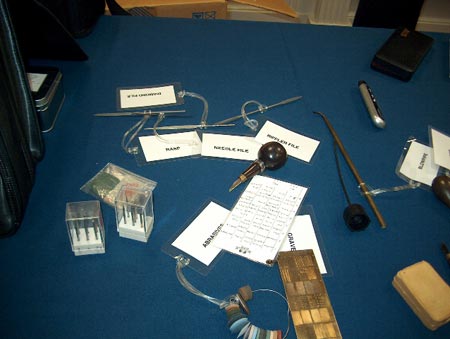
Tools the speaker uses in doing his forensic work

These are some of the tools the speaker uses in doing his forensic work regarding thefts, fire losses, etc.

Casting is a most common way of jewelry manufacturing and is known as the lost wax method and involves many steps. First a mold is made by carving a wax, either by hand or now by cad-cam. The wax is attached to a rubber base. The inside is hollow so that molten metal can be forced into the mold. Then the mold is attached to a base, and a flask is slipped over the base. Once the mold is in the flask, the cast mix or “investment” is put in a vacuum to remove the air bubbles after which it is poured into the flask. Once the investment is dried, the base and flask are removed. The piece is then put into an oven in order to burn out the wax. Next a centrifuge is used to force the melted metal into the investment mold. Duplicate molds can be made in a vulcanizer from which 400-500 pieces can be cast.

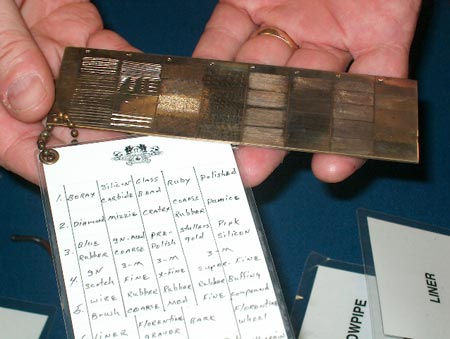
Here are some of the tools of the trade and a list of materials to check.

Here are some of the tools of the trade and a list of materials to check.

Gary brought with him some of the tools that he made or acquired over the years. They included saws, files, scrapers, gravers, burnishers and rotary brushes to name a few. By understanding the tools and the marks that they make, one can determine of a piece is old, new, how it was made and the degree of craftmanship used. He examines that back of a piece with more scrutiny than the front.

Gary Smith

And this is Gary Smith, who conducted the forensic explanations for the DCGIA chapter in Oct. 2007.

The evening concluded with the attendees examining the tools and examples of jewelry made by them.

Photos by Doris Voight

Posted in Meeting Archives | 2 Comments

Alan Hodgkinson G.G. FGA with Distinction

Dr. Alan Hodgkinson, a world-renowned gemologist, lecturer and author regaled us with a series of slides and techniques that he has developed of the years.

Dr. Hodgkinson began by reminding us that without impurities in stones, there would be no colour! It is the impurities that give us the red in a ruby, the green in an emerald and blue in sapphire and all the other wonderful colours we enjoy in the world of gemstones. What a joyless world we would live in if all we had to choose from were colourless stones!

alan-hodgkinsons-visit-2-006.jpg

The group attending the meeting presentation by Alan Hodgkinson

The first stone highlighted in the slideshow was a favourite among jewelers, the elusive alexandrite! One would think that the most intriguing aspect of this phenomenal stone would be the colour change. He gave us a different perspective in that it isn’t the stone that changes colour, it’s the light source that changes the colour. Indeed, he is correct. Further, an even more unusual character behavior is the fact that the stone is trichroic! Most of us don’t even consider this when viewing the stone. We simply look for the change and move on. This stone has a “traffic light” configuration with the trichroism being red, amber and green, depending on the direction viewed.

Dr. Hodgkinson shared with us an incident when he nearly confused an alexandrite with a ruby because he only viewed it under a tungsten bulb. The stone in question was remarkably similar to some other rubies he was working with. He did a refractive index and discovered that it was biaxial and not uniaxial as the corundum would be. This was confusing as he had already decided he had a ruby. After walking outside into daylight, the stone changed to green! His point was to observe all behaviour when taking RI’s and not just the difference in the movement. Another easy confusion is between amethyst and scapolite. Both are uniaxial but the quartz is positive and the scapolite is negative. He also recommended that RI’s be taken out to the third decimal place for a more accurate identification.

alan-hodgkinsons-visit-2-016.jpg

Alan drawing the winning 50/50 ticket at meeting

He also mentioned the use of filters for assisting in identifying emeralds, natural and synthetic and dyed or stained jadeite. He has recently developed two filters along with Dr. Hanneman. The jadeite filter will turn a stained green stone red. The same for some synthetic emeralds with exceptions being some Russian and Biron stones. He indicated that a spectroscope would easily separate the Biron, now Tairus stones.

alan-hodgkinsons-visit-2-020.jpg

Bobby & Theresa with Alan & Charlotte at meeting’s end

Opals were highlighted by showing examples of natural stones that had the lizard skin or chickenwire appearance under magnification. He showed examples of atypical opals that were green and yellow, resembling chrysoprase. He also informed us that synthetic opal is now being produced in such thickness that the coloumns of colour can be cut horizontally and used for assembled stones.

He finished with a bit of Scottish gemology by teaching that there is a polarized strip in the sky and all we need is a second polarized lens, i.e. sunglasses, to make our own, always present, polariscope!

alan-hodgkinsons-visit-2-021.jpg

Dinner upstairs with Alan & Charlote

Photos by Bobby Mann

Posted in Meeting Archives | Leave a comment

Alan Hodgkinson Workshops

On September 16 and 17, 2007, members of the DC GIA Alumni Association had the opportunity and privilege to attend two workshops presented by Mr. Alan Hodgkinson of Scotland, a renowned gemologist, author, and instructor. Each day comprised a morning session on “Visual Optics” and an afternoon session on spectroscopy. Slide presentation material and substantial hands-on experience were combined in a manner to enable participants to both understand and practice the subject techniques. The following summary is based on attendance at the presentations given September 17th.

Dr. and Mrs. Alan Hodgkinson

Dr. and Mrs. Alan Hodgkinson

Visual Optics

“Visual Optics” is a system created by Mr. Hodgkinson for deriving information on gemological properties by observation of the light patterns seen when a viewer holds a transparent, faceted stone up to his or her eye and looks through the stone toward a concentrated light source. Five principal types of information obtained through this technique were covered: (1) Determination of whether a stone is singly or doubly refractive; (2) estimation of the relative degree of birefringence; (3) estimation of the relative degree of dispersion; (4) recognition of characteristic patterns of particular gems; and (5) estimation and measurement of refractive index.

More specifically, a doubling of the light images (bright spots against a dark background) indicates a doubly refractive stone. The closeness or separation of the two parts of a doubled imaged suggests a lesser or greater degree, respectively, of birefringence. Where the images reveal spectral colors, the amount of elongation or spreading of the spectrum (i.e., stretching of the distance from the red to the violet) increases as dispersion increases. With respect to characteristic patterns, examples included ruby (only red and blue colors are evident), as well as observable differences that can distinguish diamond (tiny, sharp secondary spectral spots), synthetic moissanite (larger, blurred secondary spectral spots), and cubic zirconia (few but primary spectral spots). Concerning refractive index, light images closer to the center of the gem indicate a lower RI, with the distance of the light images from the center of the gem increasing as the RI increases. More precise measurement of RI (and of birefringence and dispersion, where applicable) can also be made through use of a scale and apparatus developed by Mr. Hodgkinson and Mr. William Hanneman know as the Hanneman-Hodgkinson Refractometer.

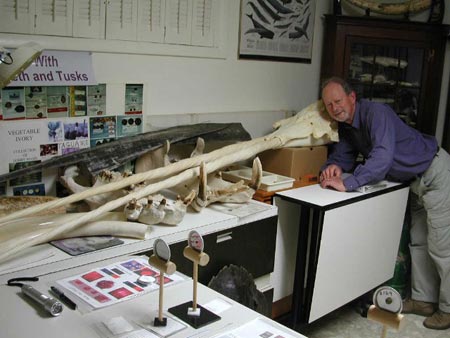
Alan Hodgkinson playfully poses with two of Bobby Mann’s huge narwhal treasures.

Alan Hodgkinson playfully poses with two of Bobby Mann’s huge narwhal treasures.

Spectroscopy

The spectroscope workshop focused on two primary aims: (1) Spectroscope lighting and use techniques; and (2) recognition of characteristic spectrum patterns. Mr. Hodgkinson offered a wealth of tips and tricks for creating an effective viewing geometry and properly lighting different stones. Vivid analogies drawn from air travel, sporting events, and even classic childhood stories helped participants make subtle adjustments to improve the visibility of spectral lines and to remember key distinctions between gemstone species. Critically, a great deal of time during this portion was devoted to practicing with a wide variety of stones, actually trying to disc ern the spectral patterns and to learn by trial, error, and adjustment to become more adept at coaxing secrets and identities from otherwise silent objects of mystery, beauty, and delight. Eureka moments abounded.

The class members at Alan Hodgkinson’s workshop at Bobby Mann’s.

The class members at Alan Hodgkinson’s workshop at Bobby Mann’s.

Conclusion

In summary, the chance to learn from a master such as Mr. Hodgkinson was an opportunity not to be missed and for which I, for one, am deeply grateful. I offer my appreciation to Mr. Hodgkinson himself, to Mr. Bobby Mann for his efforts in making these workshops a reality, and to the DC GIA Alumni Association for providing yet another presentation of the highest caliber to feed an insatiable thirst for in-depth knowledge of all things gemological.

Text by Andrea R. Blake
Photos by Bobby Mann

Posted in Meeting Archives | 1 Comment

Donna Baker

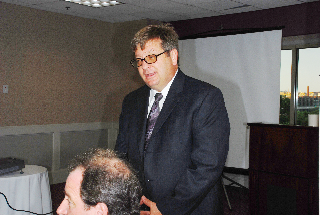
On August 14, 2007 we were treated to GIA President Donna Baker. Donna is the fifth president in GIA’s 75-year history and the first woman to hold this prestigious position. She was recruited first as an in-house lawyer and holds several degrees as well as a G.G.

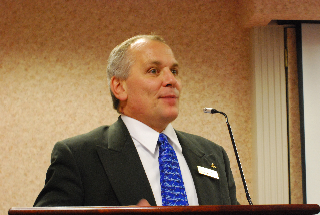
DCGIA Chapter President Tony Conway

DCGIA Chapter President Tony Conway

President Tony Conway starting the meeting

She began by recalling the changes in the laboratories with regards to improving services and turn-around times for stone grading. This was done after a Business Process Re-engineering which was done to determine how procedures were being performed and where improvements could be made. The first was the labs to be followed by Instrumentation. Instrumentation will be evaluated from design to manufacturing and will be revamped where necessary. Finally, Education will be addressed in 2008.

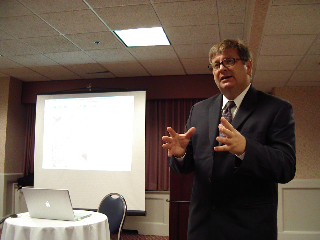
GIA President Donna Baker speaking

GIA President Donna Baker speaking

Diamond grading in the labs for both full reports and the Dossiers was taking four to six weeks to complete. This has been greatly improved and will be down to 5 days by 2008. There will also be opportunity to have a Dossier on stones weighing up to 2 cts. instead of only up to 1 ct. In order to accomplish this, the capacity for grading was increased by 50%. The website has a section for tracking the progress of any stone submitted which includes those by private individuals.

GIA President Donna Baker speaking2

GIA President Donna Baker speaking

The same is being done in colored stones. The colored stone reports have been expanded upon to include country of origin. There plans for a quality and origin report for pearls.

Another change was to open the Alumni Association at headquarters to all students and graduates, free of charge. This will help keep alumni better connected both worldwide and in their local areas.

GIA President Donna Baker in the audience

GIA President Donna Baker in the audience

Donna spoke of the changing global conditions in the industry as a whole. India and China are emerging as major players. India now cuts and finishes many of the finer grades of stones instead of the lower end goods that it was previously known to produce. Botswana has changing laws that are allowing cutting and finishing to be done in-country. This is expected to impact India as well as increase social benefits for Botswana. The global markets are growing while the middle class areas are declining.

GIA president Donna Baker speaking to members

GIA president Donna Baker speaking to members

There are plans to open schools and labs in other world markets. In order to do this, the responsibility of maintaining the level of standard that GIA has enjoyed will be great. One way to do this is by increased mechanization thereby reducing the level of human error. Donna feels that GIA is the standard bearer of the industry and she plans to make sure that this will carry through no matter where the labs and schools are located.

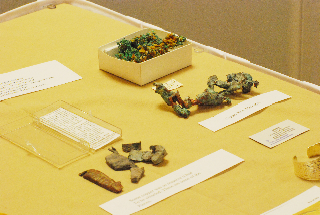
Courtland Lee's native copper exhibit

Courtland Lee's native copper exhibit

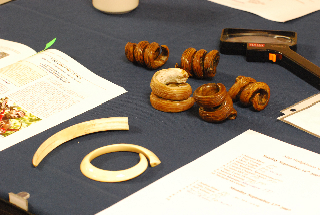
Bobby Mann's pig tusks

Bobby Mann's pig tusks

Donna finished the evening by fielding questions that ranged from policy and procedure in the labs, to trends in the industry, colored stone markets, and countless other areas that affect the gemological world.

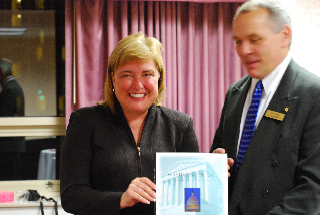
Donna Baker and Tony Conway

Donna Baker and Tony Conway

Text by Sherlene Bradbury

Photos by Melanie Marts
Posted in Meeting Archives | Leave a comment

Robert Weldon

“Gemstones of the World”

Robert Weldon

Robert Weldon

Photographer and former senior writer and Director of Photography of Professional Jewelers Magazine.

Current Manager of Photography and Visual Communications, GIA Library and Information Center was the speaker on July 23rd 2007.

pic2

Well traveled Robert Weldon gave a rich presentation covering the world of gems. The message was that the world of gemstones is changing, whether for good or bad remains to be seen. In either case major changes will affect the mining, distribution, imports and treatments of gemstones during the next decade. Globalization, including ever-changing circumstances, is condensing the gem-industry as a whole.

pic3Currently a major shortage of rough gem material has affected the world market. Good rough material is moving to other areas outside the USA faster than ever before, and the weakness of the dollar has clearly affected the routing of fine gem material. Some mines require more advanced technology as mines are drying up, and it becomes more difficult to extract gems in several regions. The lines of distribution are getting shorter and the middle man is being eliminated as a result of environmental, political, and demographic changes.

131

Millions of carats of some gems are controlled by a small number of people and companies who manage the entire production-line. One gem, Bolivian ametrine, is now in the hands of a single company which controls mining, cutting, setting and retailing the gem from beginning to end. This vertical integration can facilitate stable prices and retain complete control of distribution. The “Tanzanite 1” marketing group is another vertical integration example of an aggressive Tanzanite-only world-wide marketing effort. Their main targets include the Carribean, Europe and Russia.

133

Regulatory permits, licensing requirements, and possible non-compliance has created the recent irradiated blue topaz “debacle” which has resulted in several major retailers returning their blue topaz stock to their suppliers. Supposedly 10 million dollars worth of blue topaz has been withdrawn from the market. The jewelry trade has responded by calling for a meeting with the Nuclear Regulatory Commission. This will certainly not be the end of this issue. Not too long ago several American stores refused to sell Tanzanite because of “terrorist ties” as the media reported. Publicity without the substantiation of facts can damage a specific gemstone’s marketability very quickly, and in the end Tanzanite sales had nothing to do with financing terrorism, as was verified later by a State Department announcement. Unfortunately by then the mining and distribution were affected to the point of causing needless financial hardship and suffering for many.

136

Mr. Weldon emphasized the importance of social responsibility in the marketing and mining of gems in today’s very aware world. Columbia Gemhouse’s method of actually advertising their commitment to marketing “Fair Trade Gems” was given as an example. They have no trouble selling their “Socially Acceptable” African color. The tsavorite mines of Lemshuko in Tanzania provide schools, teachers and educational material to the families of miners and responsible mine owners like Campbell Bridges are actively exploring different ways to make their mines safer.

138

The wide variety of photos from Mr. Weldon’s travels included beautiful scenes from Columbia where the vegetation mimics what comes out of the ground…stunning green Muzo emeralds! The current president of Columbia is actively moving toward stabilizing his country, but the efforts to create openness, welcome debate and scrutiny by one important “Esmaldero” ended in his tragic death. His efforts to allow miners to earn proceeds, allow wives to join their husbands, and build roads and a laboratory are now on hold.

140

A shrinking world facilitates the travels of Tanzanians selling their products in Idar Oberstein, and German buyers frequently travel to Brazil. Competing in this ever-shrinking circle is becoming increasingly difficult. The time may be right to visit sights where gemstones are born and gain first hand knowledge about gems. Burma however is not a place where one should travel without considerable caution. It is a beautiful place with beautiful people and lots of wonderful gems. It is the Government that has created a difficult environment and the US embargo is driving the poor into even more poverty without truly stopping gems from leaving the country. Burmese gems still find their way to the cutting factories in Thailand and China and are then exported world-wide.
1874

Promising future markets include India (with a population on 300 million people) and China, which is expected to show a huge market growth within the next decade. Already these countries are purchasing major amounts of rough gem material around the globe. With the US dollar’s value shrinking it is inevitable that gem prices will also rise in the United States. It has already been noticed that the US low end sales have dropped considerably, the middle range has shown some decline, and only the high end is experiencing stable sales. Unique and rare jewelry and gems are selling well.

The internet has created a world marketplace, but has also created a source of misinformation, and untruths, which make it more difficult for the independent, well educated, experienced jeweler to compete. More transparency, safeguarding of the environment, fair labor conditions, disclosure, education and familiarity with the sources of gemstones may well provide a stable and positive future for gem-sales and the jewelry trade as a whole. Environmental consciousness is clearly on the rise, shown by the increasing number of consumers who are actively involved in questioning sources and social issues. Statistically 89% of people want a good-cause product, and that may well be the ultimate success story!

Summary by Denise Nelson

Photo by Denise Nelson

Posted in Meeting Archives | Leave a comment

The Mines and Gemstones of Minas Gerais, Brazil

Denise Nelson

Denise Nelson

Denise Nelson of Inner Circle gave us a virtual tour of some of the mining areas of Minas Gerais, Brazil during our June 21st meeting. She began visiting the mines four years ago and has become an engaging speaker on the topic accompanied by photos showing the different areas and techniques.

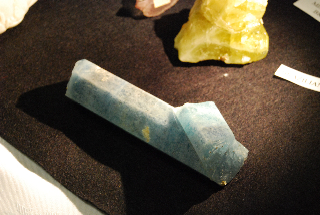
Aquamarine, Rosequartz, Bicolored Amethyst

Aquamarine, Rosequartz, Bicolored Amethyst

Belo Horizonte is the current, gem-industry driven capitol of the province of Minas Gerais, and is also the home to numerous private gem collections. The cities of Gov. Valadares and Teofilo Otoni are centers of active gem trading, cutting and marketing..

 Rough Imperial Topaz crystals from  the  Ouro Preto region

Rough Imperial Topaz crystals from the Ouro Preto region

The Itabira region is known for being iron-rich, as well as a producer of emeralds. The key to locating emeralds here is the contrasting white calcite and black biotitic and chloride shist. This indicates the presence of emeralds. The mining in this area consists of shaft and tunnel-mining.

Natural color blue Topaz necklace, Watermelon Tourmaline and  Garnet cabochons from Minas Gerais

Natural color blue Topaz necklace, Watermelon Tourmaline and Garnet cabochons from Minas Gerais

We got a look at historic Ouro Preto which means “black gold” (not Texas tea) and was once the capital of Minas Gerais. We saw many gold-decorated buildings in the colonial style and there is a historic Mineralogy Museums as well as a world-famous School of Mining. Imperial Topaz was discovered in the surrounding area in 1735, just a few years after the big diamond discovery near the town of Diamantina. This alluvial diamond deposit provided most of the world’s gem-diamonds for 150 years, before the South African discoveries.

Rough Tourmaline crystals in Quartz, collected in Minas Gerais

Rough Tourmaline crystals in Quartz, collected in Minas Gerais

The Navigator mine rights are privately owned and one of the richest producers of a variety of minerals and gem-stones Brazil is famous for. It is a cave mine and dynamite is used in the process.

Some of the mines are quite primitive, literal holes in the ground while others have some of the latest equipment and technology available.

Citrines after heat-treatment

Citrines after heat-treatment

South of Minas Gerais, in Rio Grande del Sul tunnel mining leads to large amounts of quartz geodes. Here, the geodes range from the small to the enormous.. Some of the geodes are heated prior to being offered for sale to turn the sublime into fantastic citrine, and darken the color of purple amethyst. Another region produces opal, which is harder and tends to craze less than some of the Australian counterparts.

A brazilian crystal from Courtland Lee's table

A brazilian crystal from Courtland Lee's table

One last tidbit that Denise shared was that in cutting the stones that the mines yield, calibration has not always been a priority. They have always cut to retain weight. The cutters have recently discovered that they can get more for the stones if they are cut to calibration and have begun doing so. They are now producing, along with standard shapes, excellent innovative and unique cuts complimenting bi-colored Tourmaline and Quartz.

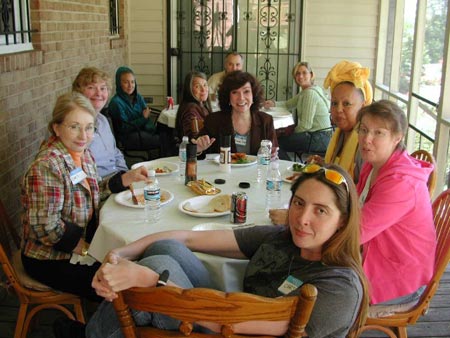
A table of members having a pre meeting discussion

A table of members having a pre meeting discussion

The jewelry that is designed by Brazilians is very contemporary and bold. They are not averse to using cabochons and highly included gems as well. Many of their designs incorporate natural crystals. One of the more impressive pieces shown was a suite made of purplish-red imperial topaz crystals and gold.

Ira Kramer, Dennis Nelson, and Denise Nelson

Ira Kramer, Dennis Nelson, and Denise Nelson

In closing, Denise had several stones and crystals that she has collected during her last three trips and we were given the opportunity to examine up close some of the wonders of Brazil!

Posted in Meeting Archives | Leave a comment

Dr. Richard Kurin

Dr. Richard Kurin

Dr. Richard Kurin

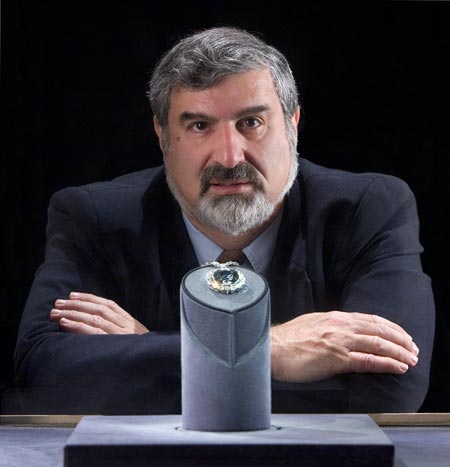
May 15th was a magical evening with Dr. Richard Kurin, Director of the Center for Folklife and Cultural Heritage, part of the Smithsonian Museum complex. Dr. Kurin recently authored: Hope Diamond: The Legendary History of a Cursed Gem.

With 13 years of study already, Dr. Kurin is still collecting facts and lore about this mysterious gem and will be authoring a second edition.

The study began when a group of Smithsonian scholars decided to get to know each other’s disciplines by choosing a topic that had nothing to do with their particular expertise. Dr. Kurin began his research on the Hope and presented his findings to the group, complete with a staged theft of the gem in 1993. Since then, he has immersed himself and family into following the gem’s trek through history by going to India and France in search of the truth.

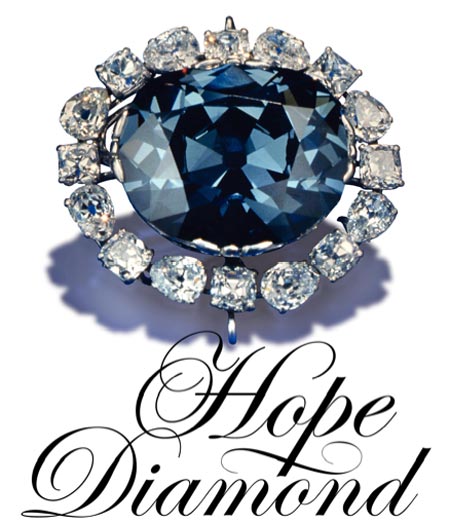
The first mention of this diamond was by Jean Baptiste Tavernier in the mid-1600’s. Tavernier visited India’s famed Golconda region and reported on mining techniques. He acquired a 112 ct. piece of rough from the Kollur mine and called it “violet”. He was able to purchase the stone easily due to the Indian belief that blue was associated with the God of Death. The stone was eventually sold to France’s Louis XIV who had it cut into a heart shape weighing 67 cts. It was renamed the French Blue. The stone was set into an adornment called the “Golden Fleece,” which was presented by members of royalty to each other. It was passed through to Louis XVI and disappeared on September 11, 1792 when the French Crown Jewels were stolen during the Revolution.

hope_diamond

Fast forward to 1804, Napoleon is in power and wants nothing more than to recover the Crown Jewels. He was never able to do that so he created a Triple Golden Fleece and presented it to himself. In 1812, a 44 ct. blue diamond appeared in the possession of Daniel Eliason of London, England who sold it to George IV of England. England and France were fighting each other so what better time to put it into a Golden Fleece for the King of England! George eventually died in debt and his last mistress absconded with many of the Crown Jewels, including the blue diamond. She was forced to return the diamond and it was sold to Henry Phillip Hope, a brother of Thomas Hope who helped secure the Louisiana Purchase. Henry called it “Stone #1” in his vast collection.

The stone then went through several more changes until it reached Joseph Frankel in 1901, who purchased it for 2.9 million dollars. The New York Times wrote a story about the bad luck of the stone because Frankel couldn’t resell it and was going bankrupt in the meantime. This was the first mention of bad luck associated with the Hope and it stemmed from a fictitious story dating back to Tavernier’s time about an entirely different diamond that had been plucked from an idol’s eye and brought bad luck to the thief. The Washington Post perpetuated the story in 1907.

Pierre Cartier finally procured the stone in 1909, read Tavernier’s lore, embellished, it and took the gem to Ned and Evalyn Walsh Mclean, who were staying at the Hotel Bristol in Paris. She was entranced by the story but didn’t like the setting around the stone. Cartier, being the smart salesman, had it reset and the transaction took place in 1911 for $180,00.00 which would be 3.9 million today.

The Mclean family history is indeed a tragedy in many ways. Their eldest son was struck by a car and died in 1919 and their daughter later committed suicide. Ned was embroiled in the Teapot Dome scandal, became and alcoholic and died institutionalized.

Harry Winston bought the Hope from the McLean estate in 1949 and later donated it to the Smithsonian Institution with the idea of creating a court of jewels for the United States. The stone in its necklace setting now rests in a special display in the Hall of Gems in the Museum of Natural History and is one of the most viewed objects in the entire complex. There are many other stories of bad luck attributed to the stone and for those, keep tuned for the next edition of Dr. Kurin’s book.

Text by Sherlene Bradbury

Posted in Meeting Archives | Leave a comment

Richard Hughes

Richard Hughes, super showman

Richard Hughes, super showman

Richard Hughes told us that gemology equals knowledge of gems, and knowledge of gems includes travel to the source. He started traveling to the source at age 18 when he first went to Nepal, and he has been traveling ever since. He is currently the Gemological Administrator and Webmaster at the American Gem Trade Association Gemological Testing Center (AGTA).

96.7 Gram Alexandrite

96.7 Gram Alexandrite

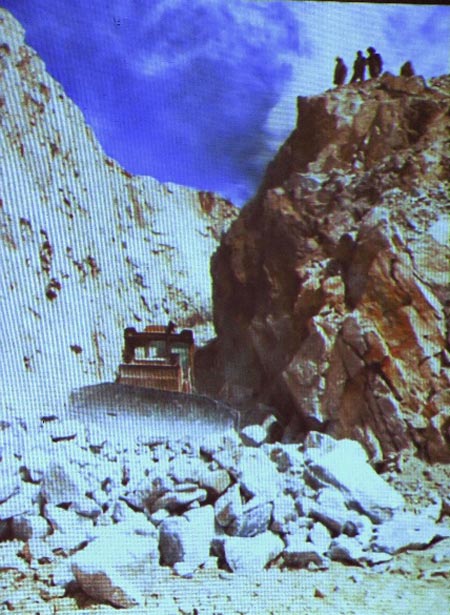
Burma jade mining heavy equipment

Burma jade mining heavy equipment

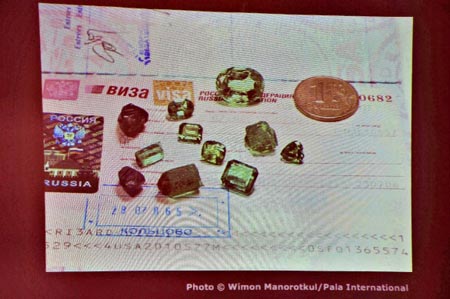
Hughes first took us to the emerald mines of Yekaterinburg in Russia. We saw pictures of the huge tunnels where beryllium used to be mined for industrial purposes, but where emeralds together with alexandrites are being mined today. Slides of emeralds depicted various inclusions: 2 phase, thin film, and mica flakes. He said that these gems may not be up to Colombian quality but they are close. This could turn out to be a major deposit not seen since the time of the czars.

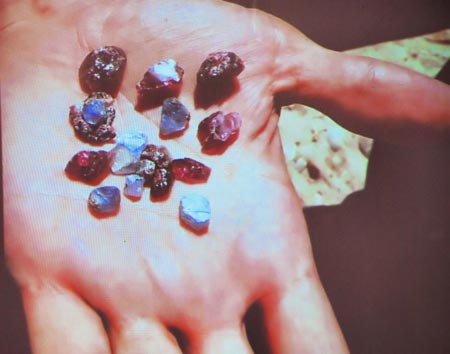
Some of the gems found in Burma

Some of the gems found in Burma

A tray of newly washed and sorted gems

A tray of newly washed and sorted gems

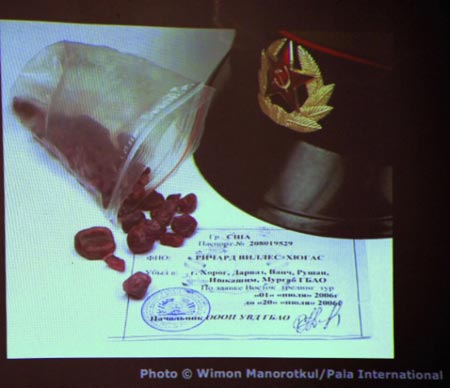
Our next stop was the spinel mines of Kuh-i-Lal, Tajikistan, in central Asia near the border with Afghanistan. This is a rugged mountainous, moonscape-like area with peaks reaching 14,000 feet. It is believed to be the source of the Black Prince’s “ruby” and the Timur “ruby”, which are both spinels in the Crown Jewels of Great Britain. The Soviets had previously mined the area for strategic minerals, but now real rubies are beginning to come from this area. Hughes tried to buy some but that is illegal. He showed photographs of the mines and some of the rubies. In addition to the Kuh-i-Lal mines we saw pictures of the mines and rubies to the east near the Chinese border in the vicinity of Snijnie.

Even gems can have passports

Even gems can have passports

And gems also need paperwork

And gems also need paperwork

Madagascar was the final stop. This island off the east coast of Africa at one time bordered India and Sri Lanka as well as East Africa before the breakup of Gondwanaland during the Jurassic and Cretaceous periods, and it therefore includes the gem-rich geological characteristics of these areas. Madagascar is the new source of rubies and sapphires in todays market—rubies in the north around Andilamena, and sapphires to the south centered in Ilakaka. In addition there are beryl, tourmaline, apatite and chrysoberyl deposits found in pegmatites throughout the island. Most of the fine pink sapphires in the market today are from Madagascar. Ninety percent of the island produces gemstones. Hughes pointed out that all of the gem production is for rough–there is no cutting industry on the island. If a cutting industry were developed then considerably more of the value of the stones would stay in Madagascar.

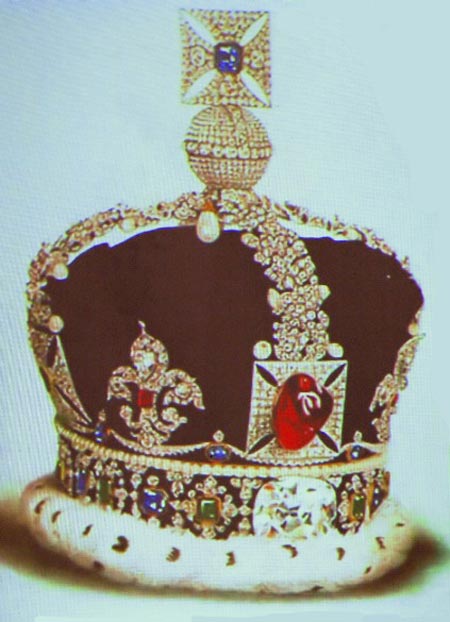
Royal crown with gems

Royal crown with gems

Hughes said that gemology is half science and half art and includes source and people. In addition to the gemology and geology his talk included not only the scenery and landscapes from the rugged mountains and deserts in Russia and Tajikistan to the jungles of Madagascar, but also photographs and discussions of the towns and different people and fauna that inhabited these lands. This was truly an informative and colorful talk, the kind that we have come to expect from Richard Hughes.

The Three Amigos

The Three Amigos

Toby Fitzkee, Denise Nelson, and Doris Voigt before the meeting

Toby Fitzkee, Denise Nelson, and Doris Voigt before the meeting

Posted in Meeting Archives | Leave a comment

The 20th Century: Art Deco, Cartier

Brenda Forman

Brenda Forman

The DC Chapter of GIA Alumni Association was treated to a look back in history as Brenda Forman, PhD presented the evolution of Art Deco as a style as well as a detailed account of the House of Cartier.

The Art Deco style flourished in all the arts after the conclusion of World War I.
The sleek, modern, minimalism could be seen in architecture, clothing design and in jewelry. Largely in preference to traditional precious gems, non-precious materials such as jet, coral, moonstone, onyx, frosted rock crystal, jade and wood became the hallmarks of the Art Deco movement.

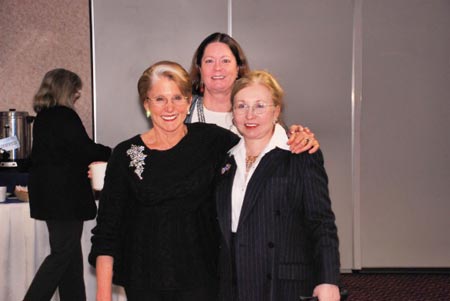
Chapter VP Doris Voigt with tonight's speaker Brenda Forman

Chapter VP Doris Voigt with tonight's speaker Brenda Forman

The House of Cartier was founded in 1847 by Louis-François Cartier in Paris. In 1874, his son Alfred Cartier took over the business and in 1899, Cartier opened its Paris office. The London store opened in 1902. The New York store opened in 1909. The New York store moved to its Fifth Avenue location in 1917, in a building traded by Morton Plant in return for a superb double-strand necklace of Oriental pearls.
The House of Cartier kept detailed, meticulous records which is a blessing for historians of 20th century jewelry. In the early 20th century, Cartier was known for its “Garland” style, which used the fineness and strength of platinum wire to create settings of lacy delicacy. As fashions changed in the 1920s, the sautoir became the signature jewel, as its long, vertical line complemented the starkly vertical lines of flapper fashions. With the discovery of King Tut’s tomb, the House of Cartier developed an Egyptian revival line of jewelry and vanity cases. In 1925, the Indian line became fashionable, the Indian Maharajahs came to Cartier to reset their fabulous gems in platinum (modern and fashionable) rather than gold (in Indian tradition, the only proper metal for setting gems).

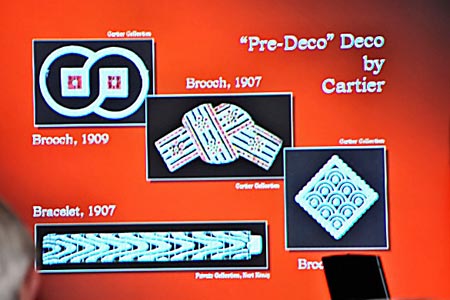
Pre-Deco jewelry by Cartier

Pre-Deco jewelry by Cartier

The “White Jewelry” style, using only platinum and diamonds, emerged in the late 1920s and lasted well into the 1930s. The “strap bracelet” was the signature jewel of the style and was a Cartier specialty. Jeanne Toussaint, Cartier’s head of “High Jewelry,” originated the “Panther” motif which has remained popular to this day.

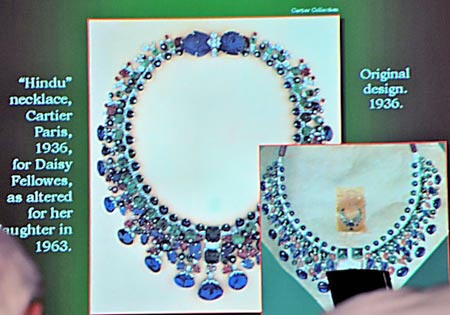
A spectacular Cartier necklace from 1936

A spectacular Cartier necklace from 1936

The members were fascinated with Dr. Forman’s delightful presentation. She combined her vast knowledge of the subject with animated anecdotes about the jewelers and their work. She has the gift to make her audience always wanting more. The DC Chapter is fortunate to have her speak and more fortunate to call her member and friend.

Posted in Meeting Archives | Leave a comment