The Kimberley Process (KP) – Brad Brooks-Rubin & Ashley Orbach

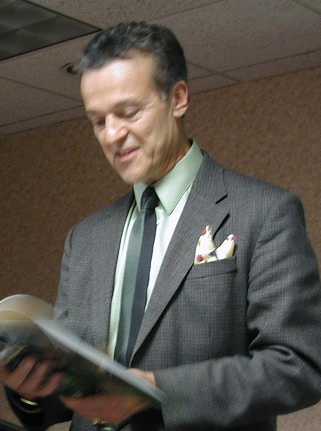
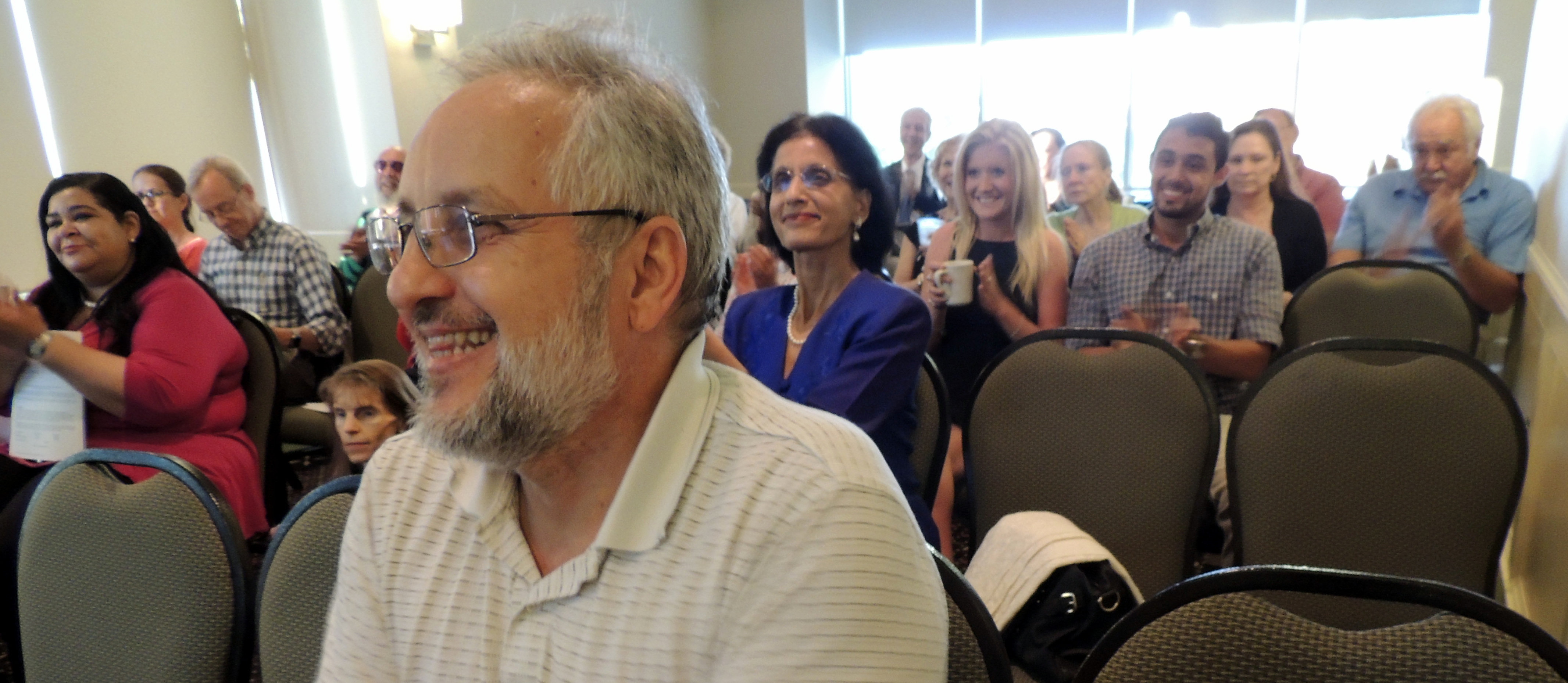
Brad The DCGIA chapter members heard from two experts (Brad Brooks-Rubin & Ashley Orbach) on responsible sourcing in the gem and jewelry trade, including the extensive work of the Kimberley Process (KP), the international practice that governs the trade in rough diamonds.

The diamond industry is very unique and special, but it’s not alone in how consumers focus on its products. There are plenty other industries such as textiles which have a found a way to deal with responsible labor and sourcing issues.

Quoting lyrics from Chance the Rapper:
The TRUTH sometimes don’t RHYME
The LIES get Millions of VIEWS

Brad highlighted how KP works and can improve. Participating member countries use the
Kimberley Process to control and monitor the trade of rough diamonds. Participants certify the $30 billion annual international rough diamond trade by creating a documentary record for rough diamonds from mine to cutting and polishing. Rough diamonds must be shipped in sealed containers and exported with a Kimberley Process Certificate which certifies that the diamonds are conflict free.

Participants understand KP is a voluntary system of industry self-regulation, and provides for a record system underpinned through verification by independent auditors of  individual companies and supported by internal penalties set by the industry. This helps to facilitate the full trace-ability of rough diamonds by government authorities. Participants also provide annual reports of official production, import and export data, shared and available to all participating members.

The thing about the KP is how much and how little it does simultaneously. On the “how much” side, rough diamonds are the only product with a worldwide certification scheme that encompasses everybody. A trade with complete oversight, including the artisanal mining sector which is often ignored in other sectors of mining. Contributing to economic development projects is the real aim of the KP.

On the “how little” side, “voluntary self-regulation” on the part of the diamond industry is represented by some as a significant lack of transparency and independent monitoring. There have been a lot of good efforts, but the process needs broader support, and broader understanding, and broader engagement, from Trade Associations, Government and Non-Government Organizations. Especially, in the review of the process and monitoring participants.

The KP is a very important tool. But it’s very specific to rough diamonds, and it is just one piece of the puzzle. A lot of people look at the KP as a one-stop shop for diamond issues, but it is not nor should it be.

Many African countries do not have sufficient tax revenues to pay for public education, unlike countries in many other parts of the world. Most African governments therefore need to charge students and their families for education. Botswana has taken a portion of diamond revenues to provide FREE schooling for children in primary school. Secondary education is 95% funded by the government, as well, enabling children to stay in school longer. Improving personal development and literacy rates and paving the way for future generations.

Revenues from diamonds also enable governments and health organizations to greatly improve existing public health services and provide new health services to those who have never had them before. Diamond revenues have funded more hospitals, more medical centers and more hospices, ensuring healthcare for millions of people.

Similar to KP the Public-Private Alliance for Responsible Minerals Trade (PPA) is a multi-sector and multi-stakeholder initiative to support supply chain solutions to conflict minerals challenges in the Democratic Republic of Congo (DRC) and the Great Lakes Region (GLR) of Central Africa. The PPA provides funding and coordination support to organizations working within the region to develop verifiable conflict-free supply chains and encourage responsible sourcing.

Brad Brooks-Rubin, is the global director of development and beneficiation at GIA, working to support GIA’s efforts to contribute to economic development projects in gem and jewelry producing countries. He also advises GIA on issues related to responsible sourcing in the gem and jewelry trade.

Ashley Orbach, was an official at the U.S. Department of State since 2003, was a senior adviser in the Economic and Business Affairs Bureau dealing with issues related to conflict and natural resources; supply chain transparency; and responsible sourcing in the extractives sector (all operations that remove natural resources from the earth).

Ashley discussed the primary goal of the U.S. Department of State, which is to shape a freer, more secure, and more prosperous world through formulating and implementing the President’s foreign policy, while supporting and protecting American interests abroad.

As it relates to KP, the State Department is responsible for international relations, with people on the ground in many countries working towards creating jobs at home by opening markets abroad and helping developing nations establish investment and export opportunities. Which brings nations together and forges partnerships to help address global problems.

Patricia Syvrud – Executive Director of the World Diamond Council was also on hand to answer questions. World Diamond Council was established to represent the diamond industry at the Kimberley Process. Website: http://www.worlddiamondcouncil.org

DCGIA thanks Brad Brooks-Rubin, Ashley Orbach and Patricia Syvrud for sharing with us!

Summary by Charles Marts – Secretary DCGIA
Posted in Meeting Archives | Tagged , , , | Leave a comment

Gem, Lapidary, and Mineral Society of DC Auction Oct. 25, 2015

Date: Sunday, October 25, 2015.
Time: Noon-1 pm preview. Auction (live and silent), 1-5 pm.

Location: Bethesda Woman’s Club, 5500 Sonoma Road, Bethesda, MD 20817.
Free parking at rear of building and on side streets.

Auction point of contact: Tony – auction @ glmsdc. org
Featuring unique minerals from one of our member’s Collection plus gemstones, jewelry, lapidary rough, books, beads, fossils, and more.

Note: To help support our club’s activities, we run the Annual Auction. The auctions are fun events that not only support our club; they are a great way to obtain gift items for your friends and family.

Visit club website at: Gem, Lapidary, and Mineral Society of DC – To increase knowledge and popular interest in earth sciences, geology, mineralogy, paleontology (Fossils), lapidary arts, and related subjects.

Posted in Meeting Archives | Tagged , , , , , | Leave a comment

Gemological Estate Sale

Estate SALE Items Check out this list of NEW and slightly used tools of the trade and books of interest to every gemologist and appraiser.

Posted in Meeting Archives | Tagged , | Leave a comment

Celebration of Life for William R. (Bobby) Mann

Bobby MannTo remember as well as celebrate the life and times of our DCGIA Co-founder, past president and friend Bobby Mann.

Please join DCGIA as the family welcomes friends and associates to visit on Saturday Oct. 3, 2015 from 1:00PM to 3:00PM at 4111 Rocky Mount Drive, Temple Hills, MD 20748.

William R. (Bobby) Mann was born on November 23, 1936 and passed away on July 20, 2015. Son of the late William S. and Virginia M. Mann, he was preceded in death by his second wife Kitty and his brother Earl.

William R. (Bobby) Mann, (GG) Graduate Gemologist (GIA) (1982), a (PG) Professional Gemologist Columbia School of Gemology (1983) and published ivory identification specialist. He was co-founder of the International Ivory Society (1996). Past President of the National Capital Area Chapter of the International Society of Appraisers and past president and founding member of the Washington, DC Chapter of the Gemological Institute of America Alumni.

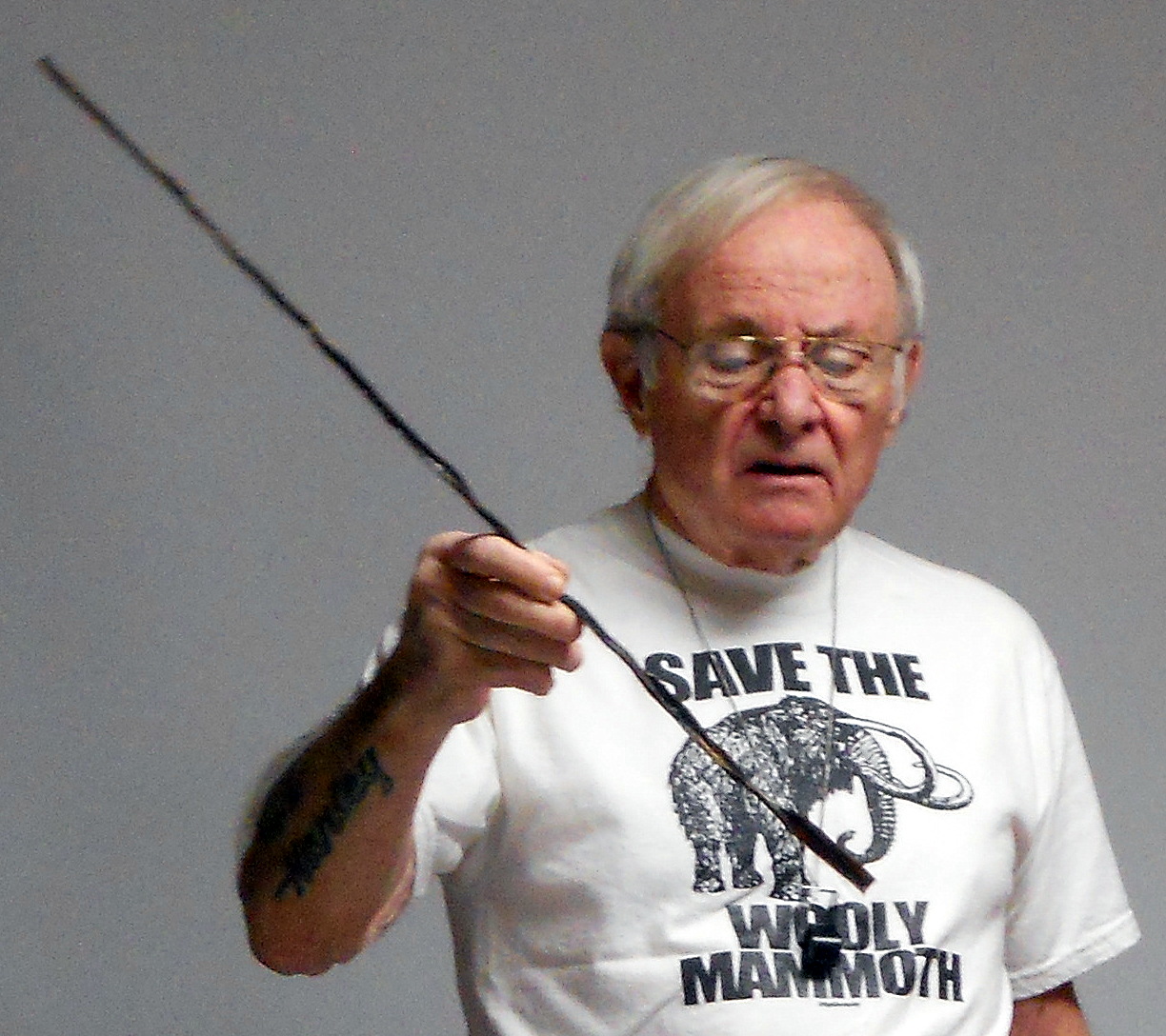
Bobby was a collector of unusual ivories, tusks, teeth, skulls, natural and manufactured ivory look-a-likes. He had the largest collection of natural ivories, as well as natural and manufactured look-a-likes, which Bobby made available for hands-on teaching. Since 1996 Bobby had dedicated time to teaching ivory identification through his talks, seminars and hands-on workshops. He was also the manufacturer of Ivory I.D. comparison kits, and Author of Ivory Identification – A Photographic Companion, available from Amazon.com.

Retired as a Captain in the Washington DC Fire Department after 28 years of service, he was also in the U.S. Navy Reserve from Nov. 1954 to Nov. 1962.

A dirt track motorcycle racer in the 1950s, Bobby was a true Harley enthusiast.

Surviving is first wife Barbara, son Mark, grandchildren Mark Jr. and Nicolas, great-grandchildren Maddie and Mason, step-son Jack Houchins, sister-in-law Christine, nephew Eric and niece Melanie Mann. Also surviving was his final love and helpmate Theresa McGowan.

Posted in Meeting Archives | Tagged , | Leave a comment

Colombian Emeralds, the Market and the Mines – Ron Ringsrud

Ron Ron shared with chapter members discussing gemology and personal stories of adventure, people, miners, and the allure of this exotic green stone! The first world emerald symposium in Bogota the location for the Symposium. The focus of the event will be the sharing of solutions in mining, gemology, sustainability and marketing. Experts from every emerald sources will be in attendance.
More Info Here Emerald Symposium

Sign up on Ron’s Mailing list to receive the Emerald news – Emerald News – published 1-2 times per year.

ClayHands ClayHands was formed to teach alternative construction methods to the people in the emerald mining region of Boyacá Colombia – that is, adobe, pressed earth and bamboo. Many of the originators of this group are emerald dealers who want to support sustainable construction and agriculture.

Ron Ringsrud is featured at the GIA Alumni Association web site and Titled “Living from Miracle to Miracle” the article describes the beginning years and adventures of an aspiring emerald dealer, a gentleman adventurer and gem hunter. Full Article

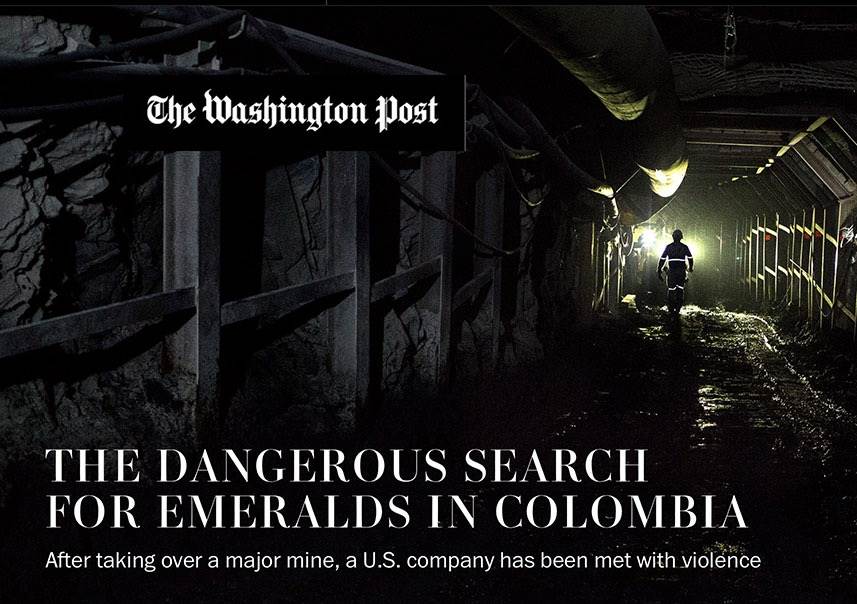
TWP Recent article in the Washington Post reported on a recent mine take over by criminal elements, so Colombia is still sometimes the wild west. Dangerous Search for Emeralds

It is hugely evident that Colombian emeralds (and other colored stones) are undervalued, their rarity and beauty still catches the attention of investors. Quality Emeralds from Colombia are superior as compared to Brazilian and African gemstones The emeralds from Colombia are considered to have the finest color, they are the yardstick by which all other emeralds are judged. It is really all about perception as a result of the chemistry.

Emeralds

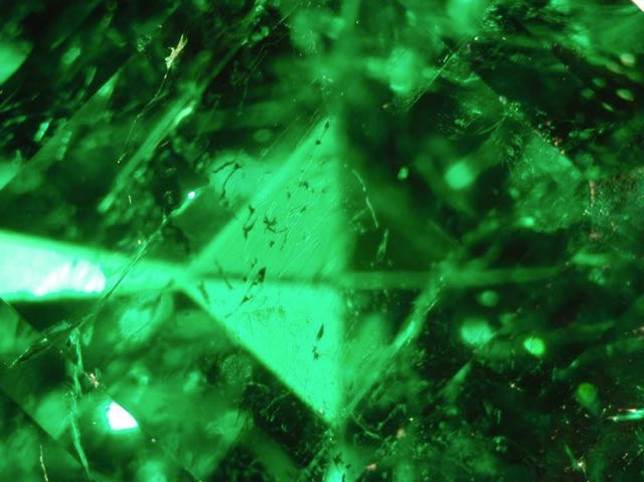
A gem material’s absorption and transmission of light is influenced by the chemicals present in the stone.  Emerald color comes from the presence of trace elements of chromium, vanadium and iron impurities in the crystal structure of the stone. These impurities have a large effect on the visible color of the crystal. The presence or absence of each of these elements determine the color, tone and saturation of the emerald. Colombian emeralds are blessed with a chemistry of color that is near perfect. Comprised mainly of chromium, a little vanadium and very little or no iron. It is the chromium that gives the green color as well as the red fluorescence. Vanadium creates the green emerald color but without the red fluorescence. Iron atoms in emerald will blunt the red fluorescence and make the green more yellowish or bluish.

Ron uses a Blue Laser, rather than a Chelsea filter, which is basically a blue filter, both will reveal hidden secrets in the different wavelengths of a stone. The Chelsea filter was originally devised to separate green glass (or any green stone) from emeralds. If the stone under the Chelsea filter looks pink or red, it is a Colombian emerald (Brazilian and African emeralds remain green due to iron content). If the stone looks green, it is something other than Colombian emerald (tourmaline or green glass, etc.). This is because of the unique spectrum of emeralds, a double peak, one in the red zone and one in the blue zone which alternatively cancel their peaks out and accentuate the trough producing what our eyes detect as “emerald green,” a color unmatched by any other gemstone. The Chelsea filter takes advantage of this by blocking the blue part of the spectrum and only allowing the red or pink to come through. The Blue Laser saturates the stone and a pink or red dot will appear.

InclusionsInclusions are a part of the natural beauty of an emerald. Emerald is harder than quartz or tourmaline and resists most scratching and wear. It is less hard than diamond and sapphire, and like all gemstones, it may be damaged if dropped or bumped hard. Also, small microscopic fissures are common to emerald due to their crystal nature and current mining methods. In the processing that takes place after cutting and polishing, emerald fissures that reach the surface (if any) are masked with a colorless oil (usually Cedarwood Oil) or resin to reduce the visibility of those fissures. This simple and low-tech process is accepted as normal by the gem industry and is called clarity enhancement which may be minor, moderate or significant. Emerald color is unaltered by this treatment and remains natural.
Emerald Books available from Ron’s website Book Emeralds, A Passionate Guide – Read about the people, the miners, the personalities and the adventurers, each caught in the allure of this exotic green stone!

DCGIA thanks Ron for sharing with us and providing the pictures of Colombian Emeralds for this post.

Summary by Charles Marts

Posted in Meeting Archives | Tagged , , , , | 2 Comments

Opals : Mine to Market – Matthew Hopkins

Matthew Hopkins discussed the early Australian mines, mining processes and the stages opal goes through to get from mine to market. Matthew Hopkins is a partner in Hopkins Opal, a family mining, cutting, jewelry design, and wholesale distributor dealing in high quality Australian Opals. Miners, cutters and wholesalers of fine quality Lightning Ridge black opal.

Opals are the product of seasonal rains that drench the dry ground in an arid places, such as Australia’s outback. The water soaks in and penetrates deep, carrying silica with it. Then, the water evaporates during a dry spell, leaving silica deposits behind forming opals.

No two opals look the same, and the play of color for each precious opal is different, giving them wide-ranging appeal. Common opal has a milky, dull color, while precious opal displays a wide range of color which makes it so valued.

Opal is a noncrystalline form of the mineral silica which, despite its amorphous structure, displays an amazing degree of internal organization. Opal is related to its more commonly found but highly crystalline cousins quartz and agate, and is formed from amorphous “balls” or lumps” of silica rather that from ordered, naturally growing crystals. Opal bearing ground is specifically searched for by opal miners.

Most of the world’s gem quality opal comes from Southern Australia, although it can be found in other parts of the world such as Brazil, Mexico, Hungry, Peru, Czechoslovakia, Nevada, Honduras, or from Ethiopia (in the last 10 years).

Most black opals come from Australia, but recent finds in Ethiopia have resulted in Black Opal. Ethiopian Opals are of from volcanic (Hydrophanic) activities. Regardsless of the origin, opals are unique and no two are exactly alike, as they come in various shapes, colors and qualities.

Fire is a nomenclature for color in opal, but the name Fire Opal is for a specific type of Mexican opal. Brazil has sedimentary opal similar to Australia. Peruvian opal is used a lot by designers as it is often a bright blue. Hungarian opal (white opal with little color) dates back to Roman times and was the only marketable opal prior to the opening of mines in Australia. Pre-1870 opal was likely Hungarian opal, so early Victorian or Georgian pieces would have had Hungarian opal. Hungarian opal is no longer actively mined.

Here are some definitions to help you in identifying each type of precious opal:

Natural Opal: A natural opal is a stone which has not been changed from its natural state in any way except to be fashioned into a gemstone through cutting and polishing.

Treated Opal: A treated opal has had some foreign material introduced into the stone. Unusually the treatment is a dye used to darken the opal (Ethiopia). Increasingly, treatments are being developed to stabilize an opal that has cracked or might crack in the future. Treated opal often seen as treated Andamooka Opal has a whitish back ground a little light, uses heated lactose and acid to carbonize the opal in order to help saturate the color making it more noticeable.

Synthetic Opal: Man-made or artificial opal grown in a laboratory and often found on silver jewelry. These opals may be sold under names like Synthetic Opal, Gilson Opal, beside Gilson there are also several other manufacturers, Inamori or Kyocera Opal (Japanese manufacturer), as well as several unspecified Russian and Chinese manufacturers. These opals may also be termed opal imitations since they have a slightly different composition than their natural opal counterpart (they lack the water content usually found in natural opal and may contain some plastic or silica compounds used to cement the silica spheres in stead of the natural water). Although created in a laboratory, these synthetic opals are often difficult to identify without laboratory tests. But there are some clues, First, if the stone has an extraordinarily bright play of color, it may be a synthetic. Next look at the pattern, as most synthetics have an overly regular pattern that looks too consistent to be natural. Synthetics also have a roundish globular (snakeskin) pattern. From the side view, high domed stones will frequently show the play of color in columns going from the top to the bottom of the stone. None of these characteristics prove that the stone is a synthetic, but taken in combination they should make you very suspicious. The Gilson Company, which produces most synthetic opals, has changed its process to produce more natural patterns. The snakeskin pattern is gone. This has made it increasingly difficult to determine when a stone is a synthetic by visual inspection.

Opal Simulates: Opal simulates are man-made materials that have the general appearance of opals-including a play of color in some cases-but are made of a different material that the silica balls of natural opal, or have significant amounts of non-silica such as plastic.

Assembled Opal: Doublets & Triplets are partially man-made stones, consisting of only a paper-thin slice of opal cemented to a black backing. Triplets have, in addition to this, a clear quartz or glass capping over the top to magnify the color, protect the opal, and give it a cabochon (domed) appearance. The idea of doublets and triplets is to imitate valuable black opals at a fraction of the cost.

Doublet

Opal Doublet

Triplet

Opal Triplet

Classification or nomenclature of natural opal has three (3) categories Type 1, Type 2, and type 3, which are defined below:

Type 1 – Commonly known as SOLID opal. A single piece of opal with a more or less homogeneous chemical composition. However some parts of the piece may be precious opal and others may be potch and it still may contain minor remains and inclusions of sandstone and other non-opal materials. Solid Opal is formed from a single piece of material, and is the most valuable.

Type 2 – Commonly known as BOULDER opal. A layer of opal that is still naturally attached to the host sedimentary rock in which it was formed (e.g. ironstone or any other rock material). The reason for this is that the layer of opal is usually too thin to be cut from the backing of host rock it was found in. Yowah nuts were found in the far South Western mines at Yowah in Queensland, Yowah nuts are ironstone concretions resembling ‘nuts’ which contain precious opal in their center. Upon cracking or slicing the Yowah nut, the precious opal is revealed inside.

Type 3 – Commonly known as MATRIX opal. The material consists of a conglomerate of minute grains of opal which are diffused as fillings in pores or holes or between grains of the host rock in which they were naturally formed (e.g. Andamooka Matrix Opal). Andamooka Matrix Opal may or may not be treated. If treated it is typically treated in a heated sugar solution and then in sulfuric acid to intensify the color, creating a dark or black background in the opal.

Also Type 3 can be a BOULDER MATRIX which is a special form of matrix opal with a different structure compared to the granular build-up of Andamooka Matrix Opal. It usually shows many fine veins and small patches of opal surrounded by the host rock.
Lightning Ridge is a mining town discovered in 1900 in New South Wales, which is the most important source of the famous Black Opal. Black Opal is a solid gemstone with rare, dark body tone that often feature an impressive play of color. These precious opals are highly valued. A black opal’s base is generally black, dark blue, dark green, or a deep gray, but sometimes can feature a whole rainbow of colors. Buyers can also find semi-black and black crystals which often display a light gray background, which is equally rare.

  • Matthew shared the following book list on opals:
  • Opal Identification and Value, Dr Paul Downing
  • Rediscover Opals in Australia, Stephen Aracic
  • Beautiful Opals series, Len Cram
  • The World of Opals, Allan Eckert 
  • Opals, Fred Ward
  • The Opal Book, Frank Leechman

In Conclusion:
Australian opals are regaining popularity worldwide.
Strong demand for opals from jewelers and designers for one-of-a-kind custom jewelry.
Production decline from the source.
Demand increases strong and steady.
High-end Australian black opal as investment possibilities.
BUY MORE OPALS!

DCGIA Thanks Matthew for sharing with us!

Summary by Charles Marts

Posted in Meeting Archives | Tagged , , , , , , , , , , , , , | Leave a comment

Natures Diversity; Natural Color Diamonds – Alan Bronstein

Alan BronsteinAlan Bronstein discussed the many beautiful creations nature provides as natural colored diamonds, in front of a full house of National Association of Jewelry Appraisers (NAJA) conference attendees and DCGIA members. Like flowers in a garden, diamonds cover every color and shade, to hold us in awe and appreciation. We were captivated with the brilliance, fire and color of each diamond Alan shared as well as the personal stories of previewing the Argyle Diamond Tender for colored diamonds he collected and dealt with during the past decades. Visit: Aurora Gems  for some wonderful pictures of colored diamonds.

NAJA + DCGIA Members

National Association of Jewelry Appraisers (NAJA) was founded in 1981 on the premise that the specialized field of gem and jewelry appraising was an area that was long overdue for representation on a professional basis. Learn more at:  NAJA

Interest in fancy colored diamonds has caused demand to increase over the last 10 years. This has caused great strain on the very limited supplies and strong upward pressure on prices. The cut of fancy colored diamonds is usually selected to maximize the intensity of the color rather than to maximize light return, which would lessen the richness of the color. The best cut for colored diamonds, is one that gives the strongest face-up color. So when cutting a colored diamond, the cutter wants a shape that will balance maximum brilliance and maximum color. GIA’s standard D-to-Z color grading system is based on the relative absence of color in diamonds, from colorless to yellow or brown, which are the diamonds most common in the retail market place.

For Fancy Colored Diamonds, GIA’s colored diamond color grading is based on the presence of color. There is a wealth of information at GIA’s Website GIA describes color in terms of hue (the color), tone (relative lightness or darkness), and saturation (intensity). Hue (like pink) is modified by a “Fancy-grade” term (Fancy Light, Fancy, Fancy Intense, Fancy Deep, Fancy Vivid or Fancy Dark) which describes the effect of both tone and saturation. Get a copy of the GIA COLORED DIAMONDS COLOR REFERENCE CHARTS “here soon”  See natural diamonds in all their colors, and where they appear on the GIA colored diamond grading scale.

Nature has given birth to many beautiful things, and among the rarest are natural colored diamonds. Colored diamonds, whether of a pure color or modified by one or more colors will always fall in a range of description based on its primary color and modifier colors if any, to include the saturation strength, vividness or amount of color present, as well as the value or tone, the scale or measurement of lightness to darkness, or white to black. Nomenclature used by most labs, such as Light, Fancy Light, Fancy. Fancy Intense, Fancy Vivid, Fancy Deep and Fancy Dark, take into account all levels of lightness, saturation, value and tone. But the dividing line between such grades can often vary between competing labs. Nomenclature used to describe the color of a diamond, Purplish Pink, will presumably take into account any stone that has a primary visible color of pink, and a secondary or modified color of purple. As long as the primary color is seen as pink, the percentage of the purple modifier can vary from 1% – 49%. While a scientific description of natural colored diamonds, it is a subjective grading and nomenclature choice, which allows differences of opinion between labs. The ranking of this nomenclature can have a major effect on the “perceived” value and desirability by customers. Beauty is not definable by a grading report or color description. Beauty is in the eye of the beholder, different to every individual and to every colored diamond. Fancy color diamond, shape, color and idiosyncrasies are what make it beautiful and unique.

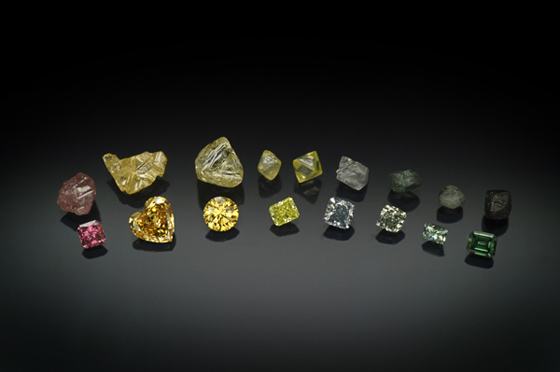
Sharing polished colored diamonds next to a piece of rough that might yield a similar color to the cut and polished diamond below it. See the 12 color varieties of natural color diamonds and their modifiers from Aurora Gems Diamond Color Variety Chart

Rough + Cut Diamonds

Copyright:Aurora Gems, Photo by Robert Weldon

Only a small percentage of diamonds show good saturated color, the color of diamonds is due to minute traces of other elements, or defects in the crystal structure. Nitrogen causes a yellow color, while boron causes blue. Radiation damage to the structure of diamond causes green, while pink diamonds result from dislocations with-in the crystal structure itself.

Colored diamonds are often best viewed in comparison with something that contrasts with what you want to see, not with something similar. In the case of colored diamonds, rough often does not show the color that cutting will yield. Looking at the picture of Colored Diamonds Rough & Polished, the Blue Diamond fifth from the right, shows almost a colorless rough from which a similar blue color might come once cut.

Rough + Cut Diamonds

Copyright:Aurora Gems,
Photo by Robert Weldon

GIA grading system tends to describe colored diamonds scientifically while also making it commercially valuable. Customers want something with a Fancy Vivid nomenclature on a report, seeing the color of the stone is often not enough.

Only a third of the world’s diamonds fluoresce when exposed to UV light. The color of emitted light may be very different from the diamond’s color in normal daylight.

We will never look at a colored diamond, much less a flower, without thinking of the wonders of nature and Alan’s passion for colored diamonds.

DCGIA & NAJA both THANK Alan for sharing his passion with us all.

Summary by Charles Marts

Posted in Meeting Archives | Tagged , , , , , , | Leave a comment

A Peek Behind the Curtain: The Edward Arthur Metzger Gem Collection – Elise Skalwold

Elise SkalwoldElise Skalwold provided an informative and passionate talk to DCGIA in A Peek Behind the Curtain: The Edward Arthur Metzger Gem Collection. The collection was donated to Cornell University in 2004. Elise presented a visual feast of rare and unusual diamonds, exquisite colored stones, gorgeous jades, exotic pearls and jewelry which were all part of this magnificent collection.

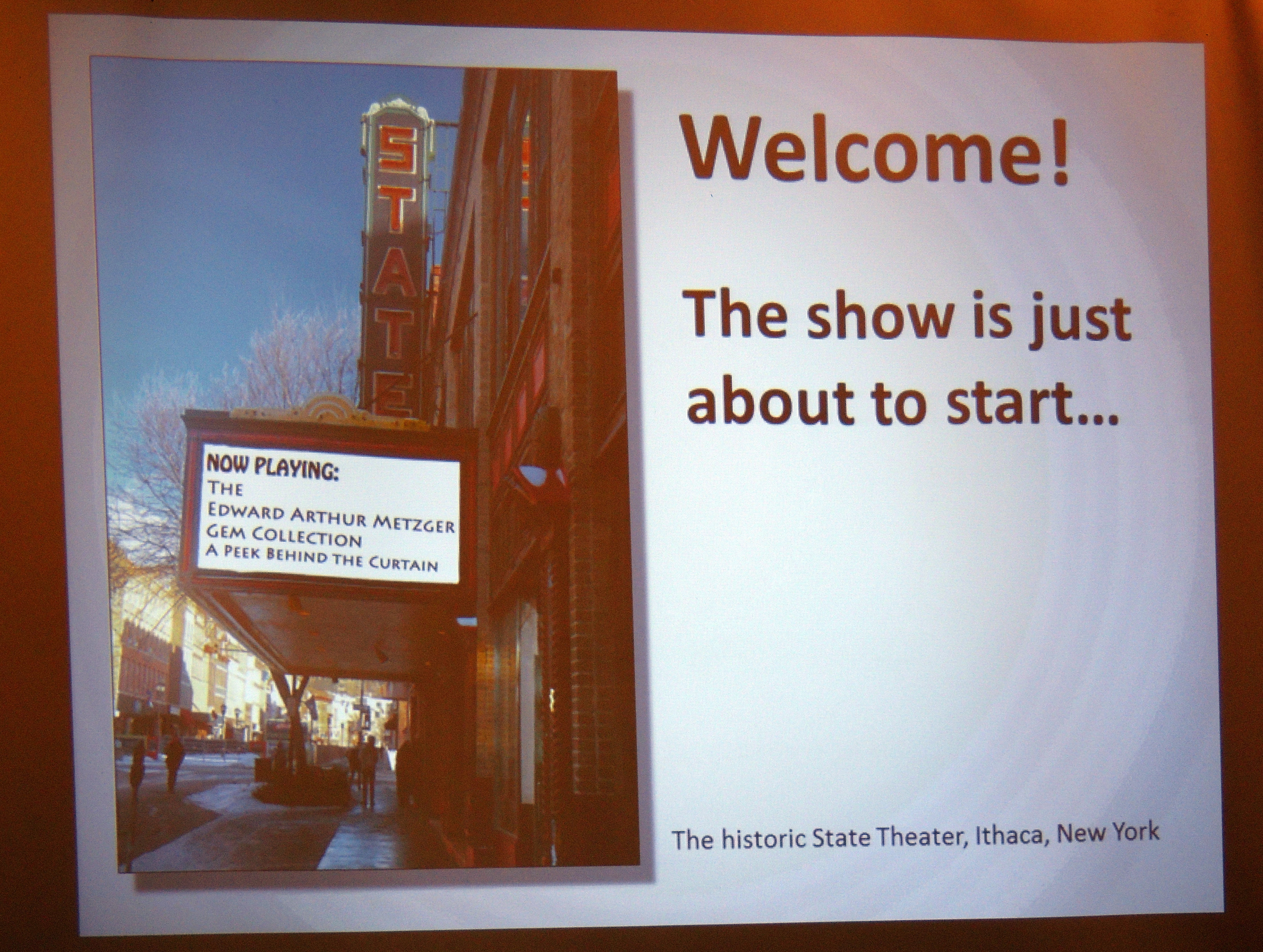
Welcome

We also gained insight into the tremendous effort it takes to document the 871-piece collection, as well as the joy being so close to such beauty brings. Elise shared the history behind the Collection and the Collector himself.

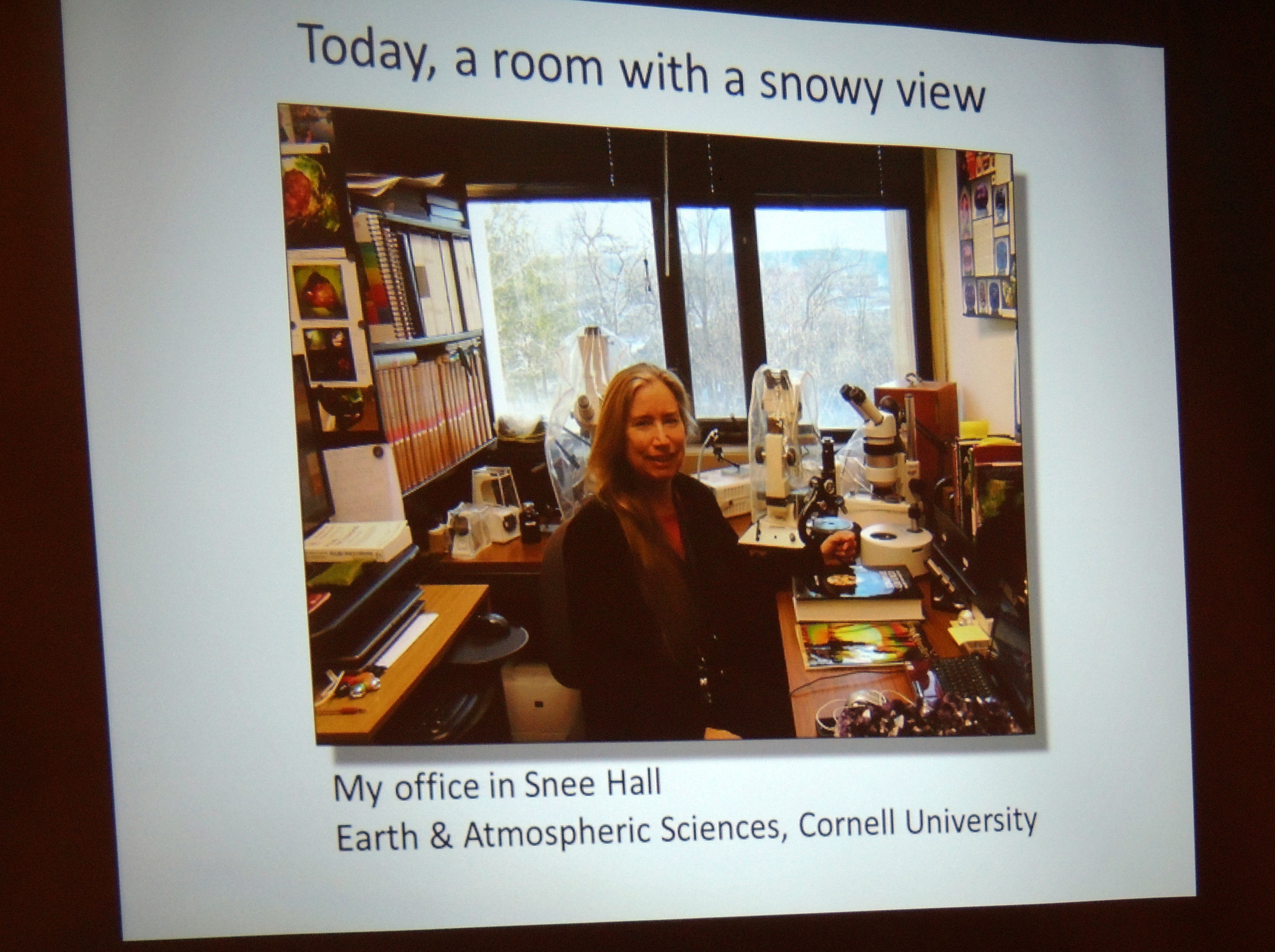
office

Central to shinning light upon the wonderful gemstones of the Edward Arthur Metzger Collection are the many people behind the curtain.

Of particular interest to the DCGIA Members was the wonderful collaboration Elise Skalwold had on this project with coauthor and friend, mineralogist Dr. William A. Bassett and longtime friend, Jeffrey A. Scovil (Grandmaster of Mineral Photography). It is Jeffrey Scovil’s skill which captures the beauty and grandor of the gems in the Metzger Collection. Elise shared some of these wonderful photos with the DCGIA members, these and many more photographs are in the Book “The Edward Arthur Metzger Gem Collection”. Authored by William A. Bassett and Elise A. Skalwold.

Book 1Elise Book

This is the first of  what will be two volumes, these books will catalog the entire Collection.
Get your copy of the 451 page book The Edward Arthur Metzger Gem Collection here.

Elise has authored/co-authored many gemology and mineralogy papers which have been featured in trade magazines like InColor, Gems & Gemology, The Journal of Gemmology and Rocks & Minerals.
Elise RM

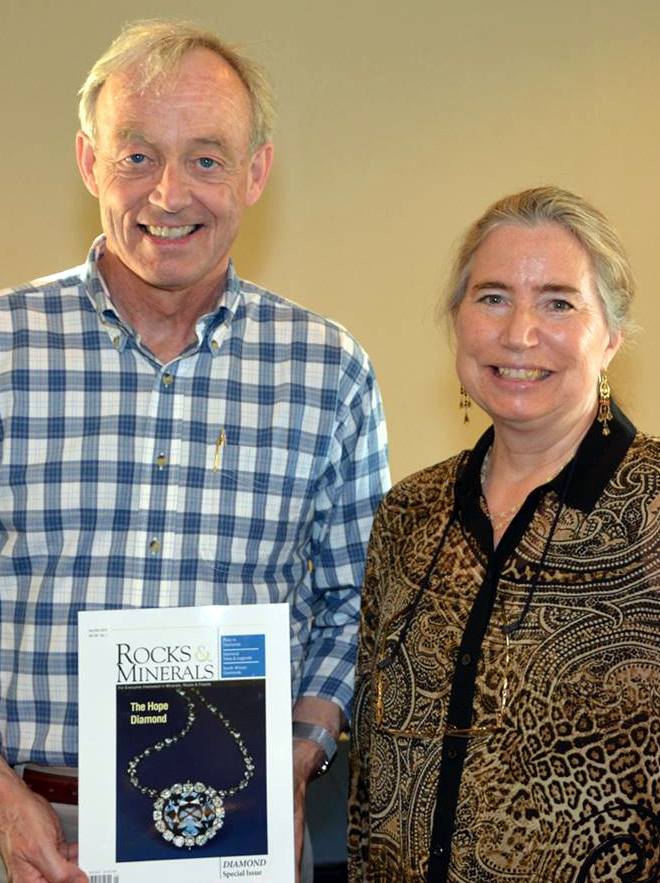
Elise provided DCGIA Members with the opportunity to get a copy of the Special diamond Issue of Rocks & Minerals which was SOLD OUT from the publisher. It was published for the 2014 Diamond anniversary of the Tucson show and is a wonderful reference on all things diamond! The article written by John Koivula and Elise Skalwold (The Microworld of Diamonds: Images from Earth’s Mantle) won 2014 Best Article of the Year! So DCGIA Members were thrilled to have the chance to pick this copy up. The Microworld of Diamonds: Images from Earth’s Mantle

DCGIA Members

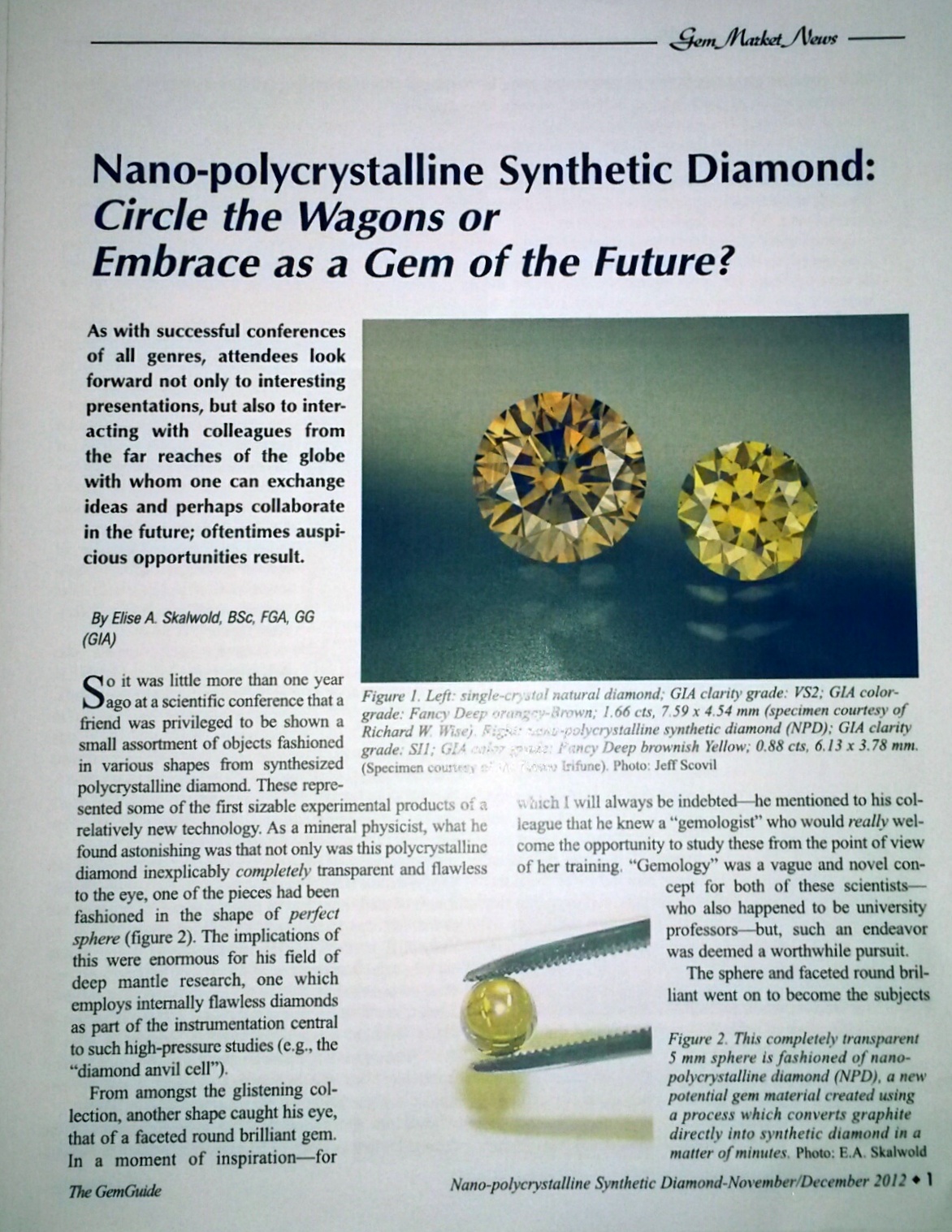
Elise in cooperation with the Richard Drucker (GemWorld/Gem Market News) also generously provided reprints of her article Nano-polycrystalline Synthetic Diamond: Circle the Wagons or Embrace as a Gem of the Future? Printed in the December 2012 issue of The Gem Guide.

NPD Nano-Polycrystalline Synthetic Diamond: Circle the Wagons or Embrace as a Gem of the Future?

Elise also directed the DCGIA Membership to reprints in two Gems & Gemology articles: Nano-Polycrystalline Diamond Sphere: A Gemologist’s Perspective
and
Characterization of a Synthetic Nano-Polycrystalline Diamond Gemstone

Gemology begins and ends with education, Elise is actively involved in bringing gemology to the university setting for the benefit of educators, students and non-students alike. This was the quintessential theme of her paper “Scholarly Treasure: The Role of Gems in a University Setting” presented at the 2013 GIA sponsored “first-ever” Gemological Session of the Geological Society of America (GSA) 125th Anniversary Annual Meeting.

DCGIA Members 2DCGIA sends a warm Thank You to Elise for sharing this wonderful topic and additional resources with us!

Summary by Charles Marts

Posted in Meeting Archives | Tagged , , , , , , , | Leave a comment

Wild Acres Jewelry Retreat

These are the topics for the talks at the fall Wildacres retreat in the Blue Ridge Mountains.

EFMLS (Eastern Federation of Mineralogical and Lapidary Societies)

24th through the 30th of August 2015

Speaker-in-residence: Denise Nelson, G.G. (Gemological institute of America), NAJA (National Association of Jewelry Appraisers),

Member Gemmological Association of Great Britain

Gemstone Enhancements: Ever-changing Technology and Discoveries

Diamonds from the “Forbidden Zone” (Namibia & South Africa mines): Plus additional insights into the future of Diamonds

Precious Heirlooms, a Message from the Past: The jewelry version of genealogical sleuthing.

The Mines and Gems of Minas Gerais: Brazilian Treasures

Tucson 2015: New and exciting rocks, surprising prices and how lots of money has transformed mineral collecting

World’s best Stone and Gem Carvings: History of Materials, Art, Tools and People

A hands-on pearl identification work shop one evening.

Here are the classes which are offered during the fall session:

Faceting–Steve Weinberger

Gem Identification–Jay Bowman

Gem Trees—Basic–Suzie Milligan

Gem Trees—Advanced–Suzie Milligan

Intarsia–Richard Shackelton

Polymer Clay–Barbara McGuire

Wildacres “Wild”–Virginia Meador

Roadside Geology–Virginia Meador

Silversmithing–Basic

Silversmithing–Intermediate

Soapstone Carving–Sandy Cline

http://efmls-wildacres.org/

Posted in Meeting Archives | Tagged , | Leave a comment

Part Time DC Sales Position Available

Part time sales/administrative position available for estate sales at family owned for 45 years jewelry store in downtown Washington DC.

Computer, sales experience helpful.

Hourly salary plus commission on sales possible.

Send resume or call.

Brian Diener, Diener Jewelers, 1133 19th St. NW, Washington DC 20036

(301)351 – 5063

bsdiener@gmail.com

http://www.dienerjewelers.com

Posted in Meeting Archives | Tagged , , , | Leave a comment