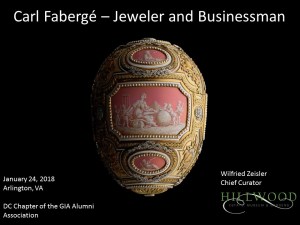
Carl Fabergé – Jeweler and Businessman

Wilfried Zeisler- DCGIADr. Wilfried Zeisler, Chief Curator Hillwood Estate, Museum & Gardens presented the history of the House of Fabergé under Carl Fabergé.

Carl Fabergé’s jewelry workshop made Fifty (50) Imperial Easter Eggs for the Russian Imperial family, from 1885 to 1916. Each taking a year or more to craft, and according to Fabergé, designs were produced in secrecy, “the only prerequisite being that they contained a surprise.”

1Presentation Fabergé Start

After the overthrow of the Tsar in 1916, the Soviet Communists sold many Imperial treasures including the Fabergé eggs as part of a policy of turning “treasures into tractors.” The introductory 45 minutes of Dr. Wilfried Zeisler presentation is available in the following video:

Imperial Easter Eggs

The Imperial Eggs can be seen at the Fabergé Website

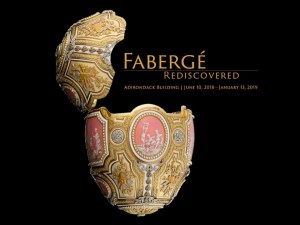
Presentation Fabergé Rediscovered June 10, 2018

Hillwood Museum will be displaying their Fabergé jewelry and eggs in an exhibition Fabergé Rediscovered from June 10, 2018 thru January 13, 2019

Ten (10) Eggs were produced from 1885 to 1893, during the reign of Emperor Alexander III. His son, Nicholas II continued the tradition adding forty (40) Eggs during his rule as Tsar of Russia. Two Eggs each year, one for his mother and one for his wife.

Of the 50 eggs 43 have been found, some as recently as 2001 and 2011. The Imperial Eggs can be viewed on the Fabergé Website.  Eight (8) were thought to have been lost. Five (5) are assumed destroyed, as there is no reference to them after 1916. If they have survived, their locations remain a mystery.

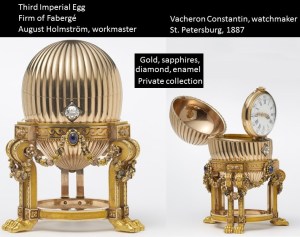
Presentation Fabergé 3rd Egg The Third Egg: Tsar Alexander III’s 1887 Easter gift to his wife, Tsarina Maria Feodorovna, was on the brink of being melted down for scrap in the U.S. in 2011, before being identified.

Its rediscovery has raised the prospect that seven others are sitting in dusty attics or on mantelpieces, as unidentified trinkets worth millions of dollars.

Seven (7) Missing Imperial Easter Eggs – Year Made and Description:
1886 Hen Egg with Sapphire Pendant
1888 Cherub Egg with Chariot
1889 Necessaire Egg
1897 Mauve Enamel Egg – Only the egg’s surprise has survived.
1902 Empire Nephrite Egg
1903 Danish Jubilee Egg
1909 Alexander II Commemorative Egg

Where are the forty three (43) Fabergé Imperial eggs today?

The Imperial Eggs can be viewed on the Fabergé Website.
Forbes Magazine Collection, New York
1885 Hen Egg
1894 Renaissance Egg
1895 Rosebud Egg
1897 Coronation Egg
1898 Lilies of the Valley Egg
1900 Cockerel Egg
1911 Bay Tree Egg
1911 Fifteenth Anniversary Egg
1916 Order of St. George Egg

Kremlin Armoury Museum, Moscow
1891 Memory of Azov Egg
1899 Bouquet of Lilies Clock Egg
1900 Trans-Siberian Railway Egg
1902 Clover Egg
1906 Moscow Kremlin Egg
1908 Alexander Palace Egg
1909 Standart Egg
1910 Alexander III Equestrian Egg
1913 Romanov Tercentenary Egg
1916 Steel Military Egg

Virginia Museum of Arts Richmond, Bequest of Lillian Thomas Pratt
1896 Revolving Miniatures Egg
1898 Pelican Egg
1903 Peter the Great Egg
1912 Czarevich Egg
1915 Red Cross Egg with Imperial Portraits

The Matilda Geddings Gray Foundation New Orleans Museum of Art
1890 Danish Palaces Egg
1893 Caucasus Egg
1912 Napoleonic Egg

The Royal Collection, Her Majesty Queen Elizabeth II
1901 Basket of Wild Flowers Egg
1910 Colonnade Egg
1914 Mosaic Egg

The Edouard and Maurice Sandoz Foundation, Switzerland
1906 Swan Egg
1908 Peacock Egg

The Marjorie Merriweather Post Collection at Hillwood Museum, Washington, DC
1895 Twelve Monograms Egg – folding screen for six miniature frames missing
1914 Grisaille Egg

The Walters Art Gallery, Baltimore
1901 Gatchina Palace Egg
1907 Rose Trellis Egg

The India Early Minshall Collection Cleveland Museum of Art
1915 Red Cross Egg with Triptych

Prince Rainier III of Monaco Collection
1895 Blue Serpent Clock Egg

Private Collections
1887 Third Imperial Egg – found in 2011 Sold in 2014
1892 Diamond Trellis Egg
1896 Alexander III Egg
1899 Pansy Egg
1907 Cradle with Garlands Egg
1913 Winter Egg

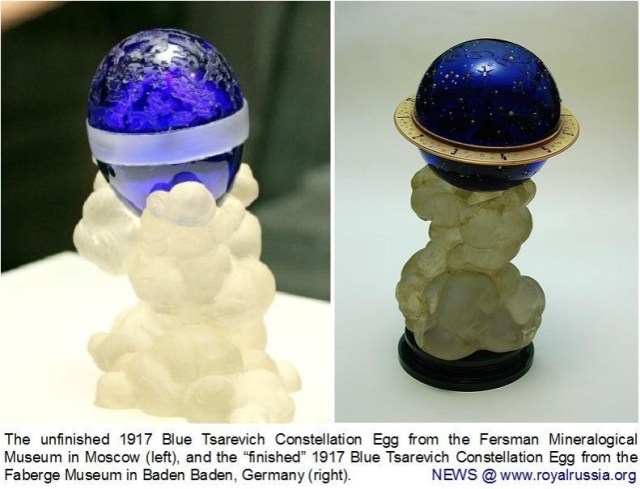
Because of the Russian Revolution, Two (2) eggs were never finished or presented.
1917 Constellation Egg  – Made for Tsaritsa Alexandra Feodorovna.
Two eggs are claimed to be the Constellation Egg:

Constellation egg

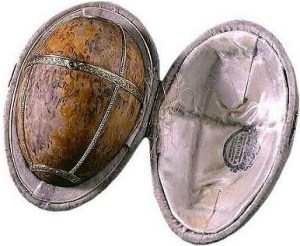
1917 Karelian Birch Egg – Surprise is missing – Made for Empress Maria Feodorovna.
Karelian Birch Egg1

Considered lost until 2001, it is currently displayed at Ivanov’s Fabergé Museum in Baden-Baden, Germany.

The DCGIA Members enjoyed Dr. Wilfried Zeisler’s informative presentation and we look forward to a field trip to the Hillwood – Fabergé Rediscovered exhibit this summer!

Posted in Meeting Archives | Tagged , , , , , | Leave a comment

2017 DCGIA Honor Roll of Donors

On behalf of the GIA Alumni & Associates of Washington, D.C. (DCGIA), I would like to thank you all for your generous support and donation(s) to our annual Holiday Auction and Dinner. List of donors is in no specific order:

1 Achikian Goldsmiths – http://www.achikian.com/

2 Tuel Jewelers – Mary Loose DiViney – http://www.tueljewelers.com/

3 Adel Cramer

4 Hoffmans Far East Gallery – http://hoffmanjade.com/

5 Mangan Jewelers – http://manganjewelers.com/

6 Gail Brett Levine – National Association of Jewelry Appraisers – http://www.najaappraisers.com/

7 Josh Hall, Pala International – http://www.palagems.com/

8 Thomas Trozzo – Cutters of Fine Gemstones – Wholesale Gem Dealer

9 Carolyn Chappell – Carolyn’s Crystals

10 Michele McMurtry – Eclectic by Design –

http://www.eclecticbydesignjewelry.com/

11 Denise & Dennis Nelson

12

13 Tim Morgan – Gemstones from the Earth –

http://www.gemstonesfromtheearth.com/

14 Courtland Lee

15 Martin Fuller – http://martinfullerappraisals.com/

16 Carol McKenna Fort

17 Kusam & Kiran Malhotra – K & K International – Gem Dealers

18 Helen Serras-Herman – Gem Art Center – http://www.gemartcenter.com/

19 GIA Alumni Association – http://www.gia.edu/

20 Skinners Auctioneers & Appraisers – http://www.skinnerinc.com/

21 Robbie & Sherlene Bradbury – http://ybassociates.net/wp/

22 The International Colored Gemstone Association – http://gemstone.org/

23 Tim Roark Inc

24 Mary Groves – Poland Mining Camps – http://www.polandminingcamps.com/

25 Mason Kay – http://www.masonkay.com/

26 Rainbow Gems – Carolyn Thornton

27 Hap + Dee Williams

28 Five Star Jewelers – Toby Fitzkee – http://www.fivestarjewelers.net/

29 Bill & Carol Anderson

30 Shannon MacMutrie

31 Anjela Proctor

32 Theresa McGowan

33 Ajax Vintage Shop – Stephanie Giorlando – www.rubylane.com/shop/ajax-vintage-shop

34 Frances Moghaddam

35 Charlie & Melanie Marts – http://charlesmarts.lnf.com/

36 Tony Conway & Donna Sibley

If I missed anyone, my profound apologies! Best Wishes and Thanks to You ALL!

Charles Marts – Secretary DCGIA

Posted in Meeting Archives | Tagged , , , , , | Leave a comment

From Collector to Commercial – Presented by Dr. Joel E. Arem

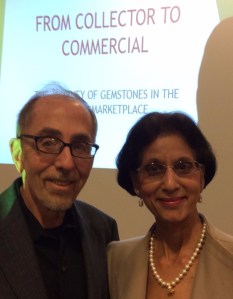
Joel Arem and Kusam Malhotra

Joel and DCGIA President Kusam Malhotra

Dr. Joel Arem took the DCGIA members on a journey to the “future of the gem industry” in the global marketplace.

EVERY gem was once a “collector” stone because only royalty could own them, and a ‘mass market’ did not exist for centuries. Over time all gems made a “transition” to the ‘commercial’ marketplace, some faster than others.

DCGIA thanks Joel for allowing us to video record his presentation and provide the Slideshow with audio as well as the video recording to members.

Because of room lighting, the projected slides are not visible in the video, so posted here is only the Slideshow with audio. There is a two slide dead period at 28 minutes as we learned the camera used had a 28 minute time limit on recording. Audio will start again after the two slides, so enjoy!

The DCGIA Board wishes once again to Thank Joel for a very informative and fun night.

Joel E Arem + DCGIA Board

Posted in Meeting Archives | Tagged , , , , , | Leave a comment

The Smithsonian Gems – Presented by Dr. Jeffrey E. Post

Jeffrey E Post + Kusam Malhotra

Jeffrey E. Post and Kusam Malhotra DCGIA President

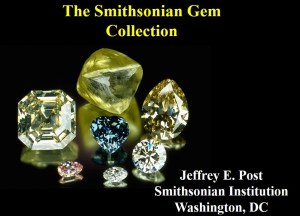
Dr. Jeffrey E. Post, provided a lively discussion on the The National Gem Collection. The history, benefactors, gems and jewelry were all fully described in the presentation as well as in the book:

“The National Gem Collection” by Smithsonian Institution and Jeffrey E. Post

Dr. Post explored the rich, fascinating stories behind some of the famous people, gems, and jewelry that made the National Collection the world’s greatest collection.

JeffPost Pic1

Historic patrons such as:
Harry Winston, who in 1958 presented the Smithsonian with the Hope Diamond. Harry Winston envisioned the institution assembling a gem collection to rival the royal treasuries of Europe — “crown jewels” that would belong to the American public.

Marjorie Merriweather Post, Cora Hubbard Williams,  Janet Annenberg Hooker, Libbie Moody Thompson, Olivia B James, just to name a few.

The Smithsonian Institution was established with funds from the estate of James Smithson (1765-1829), a chemist and mineralogist.

National Museum of Natural History – Janet Annenberg Hooker Hall of Geology, Gems, and Minerals features 2,500 minerals and gems, including the Hope Diamond, Hooker Emerald Brooch, and Star of Asia sapphire.

The Harry Winston Gallery houses the Hope Diamond.

The National Gem Collection features:

  • the Dom Pedro aquamarine, the world’s largest faceted aquamarine, cut into an obelisk standing 13.75 inches tall and weighing 10,363 carats (4.6 pounds) donated by Jane Mitchell and Jeffery Bland
  • the Cindy Chao Black Label Masterpiece Royal Butterfly Brooch (2009), composed of 2,328 gems, including sapphires, diamonds, rubies, and tsavorite (green) garnets, for a total weight of 77 carats; many of the gems fluoresce under ultraviolet light (to be added March 6, 2013)
  • 17.08 carat, color-changing Whitney Alexandrite from Coralyn Wright Whitney
  • the Marie Antoinette diamond earrings from Mrs Eleanor Barzin
  • a 263-carat diamond necklace and a diadem (tiara) given by Napoleon to Empress Marie-Louise from Marjorie Merriweather Post
  • the Janet Annenberg Hooker fancy yellow diamonds
  • 2 topaz crystals from Brazil, weighing 111 and 70 pounds respectively, and a 23,000-carat cut-and-polished topaz
  • a 423-carat sapphire set in diamonds from Mrs. John A Logan
  • the DeYoung red and pink diamonds from Sydney DeYoung
  • the 127-carat Portuguese diamond, the largest cut diamond in the collection from Harry Winston
  • the Rosser Reeves ruby
  • the Carmen Lucia Ruby, weighing 23.1-carats, is one of the largest faceted Burmese rubies known to exist. The stone is set in platinum and flanked by 2 triangular colorless diamonds measuring 1.1 and 1.27 carats. Donated by Dr. Peter Buck in memory of his loving wife, Carmen Lucia

The Minerals and Gems Gallery features some 2,000 specimens grouped by shape, color, growth, and other characteristics. The Smithsonian’s gem and mineral collection, is one of the largest of its kind in the world, with 10,000 gems and 375,000 mineral specimens, . The collection is for exhibitions and scientific research.

The Mine Gallery features a re-creation of 4 mines showing crystal pockets and ore veins in created dioramas.

There is always a full house when Jeffrey E. Post speaks, DCGIA thanks Dr. Post for shring the night with us.

Jeffrey E Post + DCGIA

Jeffrey E Post + 2

Posted in Meeting Archives | Tagged , , , | Leave a comment

GIA Updates

Kate Donovan and Tony Conway

Kate Donovan + Tony Conway 1st VP of the DCGIA Alumni 

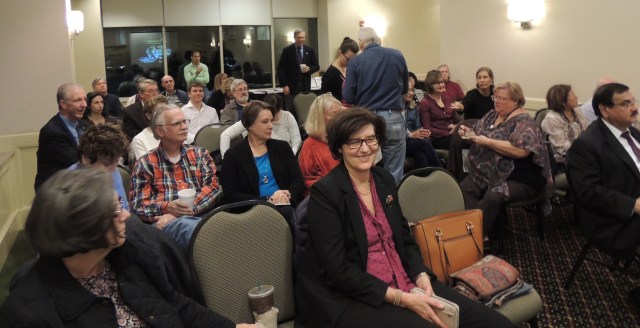
On Sept. 19, 2017, Kate Donovan, GIA Global Alumni Relations Manager, provided an update on GIA global initiatives, education, laboratory offerings, research, resources and instruments. Kate reviewed GIA’s current alumni benefits and the many programs available to support our efforts.

GIA provides a broad spectrum of education and support materials to students, graduates, the industry and the public.

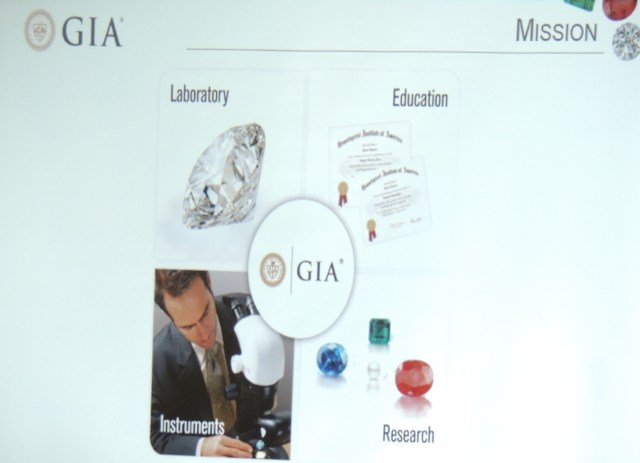
Driven by the GIA mission since 1931:

  • To ensure the public trust in gems and jewelry
  • To uphold the highest standards of integrity, academics, science and professionalism
  • Through education, laboratory services, instrument development and research

GIA Square

GIA makes resources available to everyone through the GIA Website. Archives of news, articles and the Gem + Gemology Magazine as well as many books and manuscripts which are copy right free.

Gem Encyclopedia – Get the facts on every gemstone.

Analysis + Grading – GIA is the most trusted name in diamond grading and gem identification. GIA provides integrity and accuracy in every report it issues. GIA tests every material to determine whether it is natural or not, and discloses any treatments discovered during their examination.

GIA Education – Whether starting a new career or taking the next step in your professional journey,  GIA education provides on-campus, distance learning as well as professional development in gemstones and jewelry.

Research + News – GIA is on the cutting edge of gemological research, analyzing data on gemstones and investigating gemstone characteristics. GIA is the place to learn about new gemstones, mine sources and new treatment processes, as well as, synthetic lab-grown materials which enter the market each year.

GemKids – GIA promotes the industry to both young and old alike.

DCGIA Members Thank Kate for sharing her passion for GIA and the GIA Alumni with us!

Posted in Meeting Archives | Tagged , , , | Leave a comment

Beware of Scams!

DCGIA meetings are open to the public and someones presence does not mean the individual is a GG or member of the chapter.
 
DCGIA is dismayed to hear about an issue in which a Paraiba Tourmaline was purchased last year from someone attending a meeting. When it was sent to GIA for a certificate, it turned out to be apatite.
 
DCGIA is more than happy to provide references for any of our registered members, as well as, let you know if we have no information on others who might attend and solicit business at or after the meetings.
 
Know who you are dealing with, DCGIA highly recommends you verify membership in trade organizations that help keep the industry ethical. Honest gemstone dealers often have affiliations with the BBB, AGS, AGTA, and other organizations, which we highly recommend. Additionally, education for many of are members is on-going with GIA, NAJA, ASA, and others.

Diamond Simulants

 
Always have your purchase verified by an independent jewelry appraiser, to ensure you received what was described to you. Too many synthetics and look-a-likes are out there being peddled. Price is often a great indicator, if it is a deal of the century, it is likely not a deal at all. Buyer Beware!
Posted in Announcements | Tagged , | Leave a comment

The Latest on Synthetic Diamonds | Dr. James Shigley | GIA at JCK

DCGIA thanks GIA for sharing these very informative videos!

Video #1 – Dr. Smith shares what he has learned from exceptional diamonds, such as the Cullinan and Koh-I-Noor, that formed beneath the surface of the Earth. Smith, the researcher who made the discovery, published a breakthrough article in the December 2016 issue of Science magazine.

Video #2 – Learn more about the latest developments in HPHT and CVD synthetic diamonds, the status of gem-quality synthetic diamonds in the market and the methods used by GIA to detect them.

Video #3 – Learn about the state of the Colombian emerald industry from the perspective lens of a field gemologist, as he tours Colombia’s major emerald mines and visits dealers and cutters in Bogotá.

Posted in Meeting Archives | Tagged , | Leave a comment

Museum Field Trip at Hillwood Museum

DCGIA at HillwoodThirty six (36) DCGIA members and guests enjoyed a tour of the “Spectacular Gems and Jewelry” which was Marjorie Merriweather Post’s jewel collection on display at Hillwood Museum in DC.

The tour featured an introduction to the collection by Angie Dodson, Director of Learning, then access to look at the collection on our own. We congregated at the cafe afterwards for lunch and members then returned to see the collection again and a visit to the main house to see the collection of art, furniture and other collections.

We highly recommend the Hillwood Museum as a must see attraction for everyone visiting the DC area!

We thank Tim Morgan (DCGIA Treasurer) and the Hillwood Staff for coordinating this tour opportunity for us.

Summary By: Charles Marts

Photos By: Melanie Marts & Dio Brush

Posted in Meeting Archives | Tagged , , , , , , | Leave a comment

In Memory of Lisa Carp

LisaCarpDCGIA is sad to have lost a long time and cherished member; Lisa Carp.  Lisa died on Saturday, April 15.  Lisa taught and shared her mineral and gem knowledge with DCGIA members as well as countless students who attended her gemology classes.

A memorial service will be held at the Riderwood Chapel, 3110 Gracefield Road, Silver Spring, MD on Thursday, April 27, 1-2:00 pm.  Light refreshments will follow.

The family will be sitting Shiva at 7:30 on Thursday, Saturday and Sunday evenings, April 27, 29 and 30 at the home of Lois and Bryan Geer, 616 Manorbrook Drive, Silver Spring, MD.  Interment will be at Arlington National Cemetery at a later date.

Memorials can be made to the Animal Welfare League of Montgomery County, 12 Park Avenue, Gaithersburg, MD 20877 or the Mary Ann Morris Animal Society, PO Box 1151 Bamberg, SC 29003

In Loving Memory, a loyal DCGIA member and a great friend to us all!  She will be missed but not forgotten.  Rest in Peace.

Posted in Announcements | Tagged | Leave a comment

Pearls, Questions and Answers by Teresa Tkacik, M.S.N., F.N.P.C.

teresa1Teresa provided a very informative history of pearls, how pearls are cultured, the characteristic of pearls, and Faux pearls, which included a hands on demonstration of how to evaluate pearls.

Presentation copy

Recommended reading: Tears of the Moon by Robert Verspui

Pearls are the oldest organic gem used by man, dating back to 2,300 BC in China where documentation describes pearls and their use.  Royalty coveted pearls, in China pearls were set aside for the exclusive use of Royal family.

American Royalty, Elizabeth Taylor loved her jewelry, especially pearls!  One of her favorites was La Peregrina Pearl, a 50.6-carat pearl, one of the largest natural pearls in the world, measuring approximately 0.7 inch by 1 inch in size.
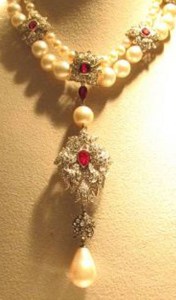
la-peregrina-pearlKing Philip II of Spain gave the pearl to Queen Mary I of England before their marriage in 1554, but after her death in 1558, the King proposed to his dead queen’s younger half-sister, Elizabeth I who wanted the pearl, but refused to marry King Philip II, so he took back La Peregrina Pearl.  The pearl was worn by Spanish royalty until the 19th century, when Napoleon Bonaparte invaded and seized the Spanish crown, and the pearl.

La Peregrina Pearl was passed down to members of the Bonaparte family, but was ultimately sold to Lord James Hamilton in 1873.  It was then sold at a Sotheby’s auction for $37,000 in 1969 to Richard Burton, who gave it to his wife, Elizabeth Taylor, as a Valentine’s Day present.  After Taylor’s death in 2011, La Peregrina Pearl was bought for 11.8 million by an anonymous buyer at a Christie’s auction. So you can see what value this pearl holds, even today.
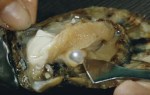
OysterTwo basic types of pearls are SEA and FRESHWATER, the names define the place of origin.
Bivalve oysters and mussels are both capable of producing pearls. Univalve Mussels may also produce pearls.

Pearls are made of Calcium carbonate and Concholin. Concholin is water mixed with minerals that act as a binder.  The pearl is formed not by sand (a myth), as it has a sophisticated filtration system, but when invaded by an intruder or the mantel is injured. First line of protection is the secretion of Concholin and then Calcuim carbonate.  It is the brick work layers of polygons (Calcium carbonate and Concholin) that allow for the prism effect of deflecting and reflecting light that gives the pearl an ability to reveal colors.

A pearl is created when a foreign object enters the oyster and or mussel and becomes lodged between the shell and inner lining or mantle.  This invader could also pick up a piece of the mantle tissue as it passes deeper inside the shell. It’s this mantle tissue
that secretes nacre around the irritant, laying down nacre in concentric layers. The shape and size of pearls, both natural and cultured, depends upon the shape and size of the nucleus used.

How to tell Real Pearls from Faux Pearls?

  1. Rub the pearl across your front tooth, it should feel gritty, not smooth.
  2. Rub two pearls of a strand together, once again they should feel gritty, not smooth.
  3. Evaluate the drill hole.  The pearl’s drilled hole is a smooth cross cut, while the faux bead will have a punched out appearance.
  4. Cultured pearls are not perfect in appearance.  Faux beads are perfectly round and smooth without defects.
  5. Over time paint chips may be noted as faux beads age.
  6. Weight of cultured pearls is heavier than faux beads.

How are Faux Pearls Made?

Anything that has value will be imitated! China was early on the scene in the first century!
Wang Chhung wrote this in a book called, Lun Heng, in the year A.D. 83: “By following the proper timing (i.e. when to begin heating and how long to go on) pearls can be made from
chemicals, just as brilliant as genuine ones.  This is the climax of Taoist learning and a triumph of their skill.”

In the 16th century Venetians learned to create iridescent glass, they blew bubbles of this glass and filled them with wax to create false pearls.

The “Pearlessence” came from a French Parisian rosary maker named, Jacquin, developing a substance called “essence d’orient or pearlessence. He realized that when fish scales were in water, they gave off a “pearly substance” which floated on the water’s surface. By mixing this iridescence with varnish, he created essence d’orient which he would eventually use to coat the insides of glass beads and fill them with wax.

Manufactured Majorica Pearls, lovely and large imitation pearls (considered the world’s finest faux pearls). Majorica pearls from Spain, started in 1890 by a German immigrant
Eduardo Hugo Heusch, made with proprietary formulas that are closely guarded secrets. Majorica or Mallorca pearls are a carefully designed nuclei dipped in high quality essence d’orient and polished between dippings.  A special final coating is applied and to prevent deterioration, the Majorica pearls are put under ultraviolet radiation. 2.5 million impeccable strands of faux pearls enter the market each year, including no doubt, 20 mm faux pearls, fake black pearls and faux graduated pearls.

Faux pearls are supposed to be clearly identified as fake pearls, but as we all know, not everyone follows the guidelines, so enjoy those fake pearls, just don’t be tricked into thinking they are real cultured or genuine natural pearls.

Don’t be tricked into buying simulated pearls.
Here are just some of the misnomers, names or words that may be used to mislead the unwary  consumer into thinking that they are buying genuine cultured or real natural pearls.

Atlas pearls: Imitation; satinspar type gypsum beads.
Cave pearls: Imitation, water-polished objects of calcium carbonate from limestone caves.
Kultured pearls: Imitation
Laguna pearls: Imitation
La Tausca pearls: Imitation
Majorica (Mallorca) pearls: Imitation
Nautilus mabe pearls: Cut and polished shell from the chamber of the nautilus mollusk
Red Sea pearls: Coral beads
River strands: Imitation pearls with mother-of-pearl core
Shell mabe: Cut and polished shell from the chamber of the nautilus mollusk
South ocean pearls: Imitation pearls with mother-of-pearl core
Semi-cultured pearls: Imitations made from cultured pearls with very poor nacre coating, over which pearlessence has been added.

Five basic characteristics of pearls are: Luster–Shape–Size–Color–Surface

LUSTER – is the most important of the five characteristics, probably because it’s the quality that’s most visible from a distance as the beauty catches your eye.  It also shows the quality and depth of nacre.  The deeper the layers, the higher the luster.  When picking out pearls look at them with your back to the light.  A fine pearl will reflect your image like a mirror.

SHAPE – round, symmetrical, baroque, other.

  • ROUND is the most favored and valuable.  Before cultured pearls were available, it could take years to make a matching necklace.  Today, with more available, matching necklaces are easier to make.
  • SYMMETRICAL Potato pearls are symmetrical, not baroque.
  • BAROQUE – Natural pearls have no nucleus.  Therefore they are most often baroque.
    Baroque is noted when there is no straight line of the axis.  Baroque is a term people use freely if a pearl is not round.
  • OTHER – infinite number of shape names given to odd shaped pearls.  Shapes vary from near round to highly irregular.  They can be equally as lovely as round and when they have a high luster, just as stunning. RICE pearls look like rice crispies and are usually used in quantity on twisted strands.  Remember that the shape of the nucleus inserted will determine the shape of the pearl.

SIZE – is measured in millimeters, the larger the higher the price, but not always, depending on nucleus size and nacre thickness.  7mm-7 1/2 mm are the most common size, 9mm to 13mm or larger are possible.

COLOR – while white with a pink overtone was originally most common and wanted, colors can be peach, black (which may be dyed), lavender, gold, silver or pink.

SURFACE – can be perfect or near perfect, contain small “pits,” or have rings around them. Most, even high quality pearls, have some imperfections.  The minor imperfections of a pearl do not detract from their beauty unless severe.

Evaluating Cultured Pearls

  1. Luster.  Which is the reflective quality of pearls. Luster is the most important pearl quality, as it is an indicator of nacre thickness, since the thicker the nacre the better the luster.  Luster produces a mirror-like quality in the pearl.
  2. Surface.  Almost all pearls have some surface imperfections, but if you can’t see the imperfections when looking at the pearls from a distance of two feet, they probably won’t be noticed by anyone else.  Therefore the slight flaws will not detract from your jewelry’s beauty.  Only you will know they are there and you do not have to tell!
  3. Shape.  Naturally, a perfect sphere is the most sought after shape, although there is a growing interest in baroque or misshapen pearls which make for very interesting jewelry designs.
  4. Color.  Cultured pearls come in a wide range of natural shades. Choose the color that you enjoy wearing, because they are all lovely.
  5. Size.  Pearl size is measured in millimeters, so familiarize yourself with the decimal system if you want to visualize the size of pearls mentioned somewhere.  After a little practice, one can easily imagine the size when you hear the diameter of a pearls in millimeters, but never rely on guessing, have the salesperson measure them for you if you want to know the exact size of pearls.  Price is often set by size as more nacre layers produce a larger size.  But remember the nucleus used to start the pearl may be 10mm of the 11mm pearl being sold.
  6. Matching Pearls.  A well matched necklace makes a statement and should be insisted upon when purchasing.  Ideally, all the five above qualities should match closely.

DCGIA thanks Teresa Tkacik for sharing her knowledge and experience of pearls with us.
T2

Tony + Becky


Summary by Charles Marts
Pictures Charles Marts and provided by Teresa Tkacik

Posted in Meeting Archives | Tagged , | 3 Comments